| SKU-Pack Size | Availability | Size | Price | |
| EAB13853-30UL | In Stock | 30ul | €141.70 | |
| EAB13853-100UL | In Stock | 100ul | €297.70 | |
| EAB13853-200UL | In Stock | 200ul | €479.70 |
| Please select the country you are in to find your local distributor. |
| Betaclonal | Phone£º+34 (0)91 471 6763 | |
| 29/1 Lomonosovsky Pr, | E-mail£ºtech@betaclonal.com | |
| Spain | Madrid, Spain | Web£ºwww.betaclonal.com |
| Product Information | |
| Applications | WB, ELISA |
| Species Reactivity | Human, Mouse, Rat |
| Host / Isotype | Rabbit IgG |
| Clonality | Polyclonal |
| Applications Dilutions | WB=1:500-2000 |
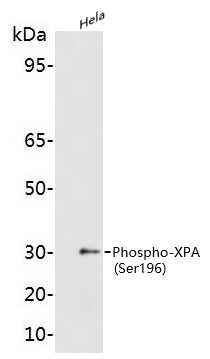
| MW (kDa) | 31 |
| Conjugate | Unconjugate |
| Specificity | Phospho-XPA (Ser196) Rabbit Polyclonal Antibody detects endogenous levels of XPA protein only when phosphorylated at Ser196. |
| Purification | Affinity purification |
| Concentration | 1mg/ml |
| Format | Liquid |
| Formulation | In PBS, pH 7.4, containing 0.02% sodium azide,0.5% BSA and 50% glycerol. |
| Shipping | Gel Pack |
| Storage | Store at -20¡ãC least 1 year from the date of shipment. avoid repeated freeze/thaw cycles. Aliquots may be stored at +4¡ãC for 1-2 weeks. |
| Research Use | For Research Use Only. Not Intended for Diagnostic or Therapeutic Use. |
| Application Key WB-Western Blot IP-Immunoprecipitation IHC-Immunohistochemistry IHC-P-Immunohistochemistry-Paraffin |
|
| Reactivity Key H-Human M-Mouse R-Rat Mk-Monkey B-Bovine Pg-Pig Hm-Hamster Dg-Dog C-Chicken X-Xenopus Z-Zebrafish |
|
| Product Bioinformatics | |
| Synonym(s) | XP1; XPAC; XPA |
| Gene Aliases | XPA |
| UniProt ID | |
| Entrez Gene ID | |
| Product Description | |
XPA also known as XP1 is a zinc finger protein plays a critical role in the nucleotide excision repair (NER) pathway, which is essential for repairing DNA damage caused by ultraviolet (UV) light. This function is particularly important as deficiencies in NER can lead to xeroderma pigmentosum, a genetic disorder that significantly increases the risk of skin cancer due to the accumulation of unrepaired DNA lesions. XPA is responsible for coordinating the assembly of the preincision complex necessary for recognizing and excising damaged DNA, and XPA exhibits a unique ability to bind to both single-stranded and double-stranded DNA, enhancing efficiency in damage recognition. |
| Product Image Gallery | |
![]() Western blot analysis of extracts on Hela cells treated with LPS, using Phospho-XPA (Ser196) Rabbit Polyclonal Antibody (EAB13853) at 1:1000 dilution. The lane on the left is blocked with the phospho peptide.
|
| Specific Protocols | |