| SKU-Pack Size | Availability | Size | Price | |
| EAB13975-30UL | In Stock | 30ul | $133.50 | |
| EAB13975-100UL | In Stock | 100ul | $298.50 | |
| EAB13975-200UL | In Stock | 200ul | $508.50 |
| Please select the country you are in to find your local distributor. |
| EbioCell | Phone:(540) 808-3925 | |
| Imperial Business Park 4819 Emperor Boulevard, | E-mail:order@ebiocell.com | |
| Canada | Suite 408 Durham, NC 27703, USA | Web:www.ebiocell.com |
| Product Information | |
| Applications | WB, IHC-P, IF/ICC, ELISA |
| Species Reactivity | Human, Mouse, Rat |
| Host / Isotype | Rabbit IgG |
| Clonality | Polyclonal |
| Applications Dilutions | WB=1:500-2000 IHC-P=1:50-300 IF/ICC=1:50-300 |
| MW (kDa) | 45 |
| Conjugate | Unconjugate |
| Specificity | PAI-1 Rabbit Polyclonal Antibody detects endogenous levels of PAI-1 protein. |
| Purification | Affinity purification |
| Concentration | 1mg/ml |
| Format | Liquid |
| Formulation | In PBS, pH 7.4, containing 0.02% sodium azide,0.5% BSA and 50% glycerol. |
| Shipping | Gel Pack |
| Storage | Store at -20°C least 1 year from the date of shipment. avoid repeated freeze/thaw cycles. Aliquots may be stored at +4°C for 1-2 weeks. |
| Research Use | For Research Use Only. Not Intended for Diagnostic or Therapeutic Use. |
| Application Key WB-Western Blot IP-Immunoprecipitation IHC-Immunohistochemistry IF-Immunofluorescence ICC-Immunocytochemistry FC-Flow Cytometry |
|
| Reactivity Key H-Human M-Mouse R-Rat Mk-Monkey B-Bovine Pg-Pig Hm-Hamster Dg-Dog C-Chicken X-Xenopus Z-Zebrafish Hr-Horse All-All Species Expected |
|
| Product Bioinformatics | |
| Synonym(s) | Plasminogen activator inhibitor 1; Serpin family E member 1; PAI; PAI1; PAI-1; PLANH1; SERPINE1 |
| Gene Aliases | SERPINE1 |
| UniProt ID | |
| Entrez Gene ID | |
| Product Description | |
PAI-1 also known as SERPINE1 is a member of the serine proteinase inhibitor (serpin) superfamily. PAI-1 plays a crucial role in regulating fibrinolysis and tissue remodeling by inhibiting urokinase-type plasminogen activator (uPA) and tissue plasminogen activator (tPA), which are essential for the conversion of plasminogen to plasmin. This regulation is vital for maintaining hemostasis and preventing excessive tissue degradation, making PAI-1 a significant factor in various physiological and pathological processes, including wound healing, cancer progression, and cardiovascular diseases. PAI-1 can exist in both active and latent forms, with the latent form being able to regain activity through denaturation and renaturation, highlighting PAI-1′s dynamic role in the regulation of proteolytic activity. The ability of PAI-1 to fold into an inactive state without cleavage underscores the complexity of PAI-1′s function and importance in cellular processes. |
| Product Image Gallery | |
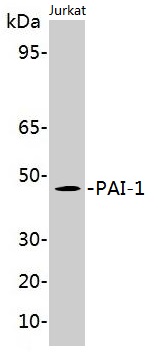
![]() Western blot analysis of extracts on Jurkat cells, using PAI-1 Rabbit Polyclonal Antibody (EAB13975) at 1:1000 dilution. Secondary antibody Goat Anti-Rabbit IgG (H&L)-HRP (EAB21002) at 1:5000 dilution.
![]() Immunohistochemistry analysis of paraffin-embedded Human brain tissue, using PAI-1 Rabbit Polyclonal Antibody (EAB13975) at 1:100 dilution.
|
| Specific Protocols | |