| SKU-Pack Size | Availability | Size | Price | |
| EAB14337-100UL | In Stock | 100ul | €297.70 |
| Please select the country you are in to find your local distributor. |
| SBT BioChem Srl | Phone£º+39 05 7156 8147 | |
| Via Ponte di Bagnolo, 811 Bologna, | E-mail£ºinfo@sbtbiochem.it | |
| Italy | Italy | Web£ºwww.sbtbiochem.it |
| Product Information | |
| Applications | WB, IF/ICC, ELISA |
| Species Reactivity | Human, Mouse, Rat |
| Host / Isotype | Rabbit IgG |
| Clonality | Polyclonal |
| Applications Dilutions | WB=1:500-2000¡¡ IF/ICC=1:50-300 |
| MW (kDa) | 300 |
| Conjugate | Unconjugate |
| Specificity | Phospho-ATR (Ser428) Rabbit Polyclonal Antibody detects endogenous levels of ATR only when phosphorylated at Ser428. |
| Purification | Affinity purification |
| Concentration | 1mg/ml |
| Format | Liquid |
| Formulation | In PBS, pH 7.4, containing 0.02% sodium azide,0.5% BSA and 50% glycerol. |
| Shipping | Gel Pack |
| Storage | Store at -20¡ãC least 1 year from the date of shipment. avoid repeated freeze/thaw cycles. Aliquots may be stored at +4¡ãC for 1-2 weeks. |
| Research Use | For Research Use Only. Not Intended for Diagnostic or Therapeutic Use. |
| Application Key WB-Western Blot IP-Immunoprecipitation IHC-Immunohistochemistry IF-Immunofluorescence ICC-Immunocytochemistry FC-Flow Cytometry |
|
| Reactivity Key H-Human M-Mouse R-Rat Mk-Monkey B-Bovine Pg-Pig Hm-Hamster Dg-Dog C-Chicken X-Xenopus Z-Zebrafish Hr-Horse All-All Species Expected |
|
| Product Bioinformatics | |
| Synonym(s) | ATR; FCTCS; FRP1; MEC1; SCKL; SCKL1 |
| Gene Aliases | ATR |
| UniProt ID | |
| Entrez Gene ID | |
| Product Description | |
ATR also known as ataxia-telangiectasia is a serine/threonine kinase and DNA damage sensor, activating cell cycle checkpoint signaling upon DNA stress. ATR plays a crucial role in the cellular response to DNA damage, particularly in the activation of cell cycle checkpoints. ATR phosphorylates key proteins involved in the DNA damage response, such as checkpoint kinase CHK1 and tumor suppressor BRCA1, making ATR vital for maintaining genomic stability. ATR is primarily located in the nucleus, where ATR forms intranuclear foci in response to DNA damage or replication stress, highlighting ATR′s importance in cellular repair mechanisms. ATR is essential for early embryonic development, underscoring ATR′s significance in both normal cellular function and the prevention of diseases associated with genomic instability. |
| Product Image Gallery | |
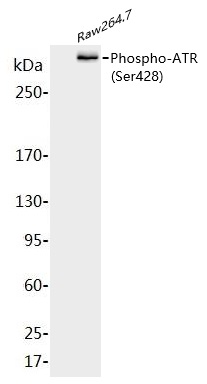
![]() Western blot analysis of extracts on Raw264.7 cells treated with UV, using Phospho-ATR (Ser428) Rabbit Polyclonal Antibody (EAB14337) at 1:1000 dilution. The lane on the left is blocked with the phospho peptide.
|
| Specific Protocols | |