

www.ebiocell.com
| Host / Isotype | Clonality | Applications | MW (kDa) | Reactivity |
| Mouse IgG1 | Monoclonal | IHC-P, IF, ELISA | 60 | Human, Mouse, Rat |
| Applications Dilutions | |
| The application notes include recommended starting dilutions;optimal dilutions/concentrations should be detemined by the end user. | |
| IHC-P=1:100-500 IF=1:100-500 |
|
| Application Key | WB-Western Blot IP-Immunoprecipitation IHC-Immunohistochemistry IHC-P-Immunohistochemistry-Paraffin |
| Reactivity Key | H-Human M-Mouse R-Rat Mk-Monkey B-Bovine Pg-Pig Hm-Hamster Dg-Dog C-Chicken X-Xenopus Z-Zebrafish |
| Product Information | |
| Conjugate | Unconjugate |
| Specificity | Acetyl-NFkB p65 (Lys314/315) Mouse Monoclonal Antibody detects endogenous levels of NFκB p65 protein only when acetylated at Lys314/315. |
| Purification | Affinity purification |
| Concentration | 1mg/ml |
| Format | Liquid |
| Formulation | In PBS, pH 7.4, containing 0.02% sodium azide,0.5% BSA and 50% glycerol. |
| Shipping | Gel Pack |
| Storage | Store at -20°C least 1 year from the date of shipment. avoid repeated freeze/thaw cycles. Aliquots may be stored at +4°C for 1-2 weeks. |
| UniProt ID | |
| Entrez Gene ID | |
| Product Description | |
NFκB p65 also known as RELA is a critical subunit of the NFκB transcription factor complex, which plays a pivotal role in regulating genes involved in immune and inflammatory responses, cell proliferation, and survival. Structurally, NFκB p65 contains a Rel homology domain (RHD) at its N-terminus responsible for DNA binding and dimerization, and a transactivation domain (TAD) at its C-terminus. The TAD, located near the C-terminus, is essential for initiating transcription by interacting with other transcriptional co-activators and the basal transcription machinery. Understanding the structure of NFκB p65 is important because alterations or post-translational modifications in these domains can significantly affect its ability to regulate gene expression, impacting processes like inflammation, immune responses, and oncogenesis. In resting cells, NFκB p65 is sequestered in the cytoplasm by inhibitor proteins called IκBs. Upon activation by various stimuli such as cytokines or stress signals, IκBs are degraded, allowing NFκB p65 to translocate to the nucleus, where NFκB p65 binds to specific DNA sequences to modulate gene expression. |
| Product Image Gallery | |
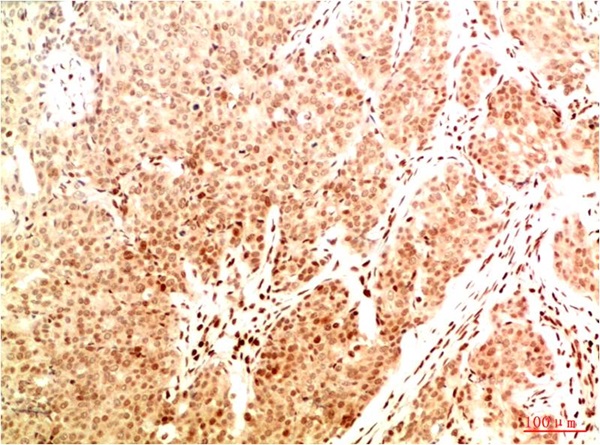 Immunohistochemical analysis of paraffin-embedded Human breast carcinoma tissue, using Acetyl-NFkB p65 (Lys314/315) Mouse Monoclonal Antibody (EAB12245) at 1:200 dilution.
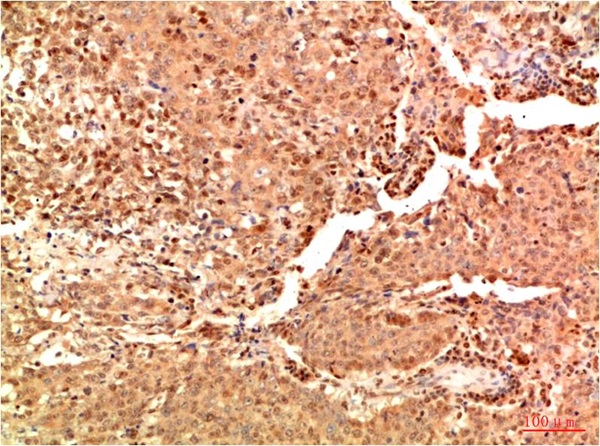 Immunohistochemical analysis of paraffin-embedded Human lung carcinoma tissue, using Acetyl-NFkB p65 (Lys314/315) Mouse Monoclonal Antibody (EAB12245) at 1:200 dilution.
|
