

| Host / Isotype | Clonality | Applications | MW (kDa) | Reactivity |
| Rabbit IgG | Monoclonal | WB, IP, IHC-P, IF/ICC | 44 | Human, Mouse, Rat |
| Application Key | WB-Western Blot IP-Immunoprecipitation IHC-Immunohistochemistry IHC-P-Immunohistochemistry-Paraffin |
| Reactivity Key | H-Human M-Mouse R-Rat Mk-Monkey B-Bovine Pg-Pig Hm-Hamster Dg-Dog C-Chicken X-Xenopus Z-Zebrafish |
| Applications Dilutions | |
| The application notes include recommended starting dilutions;optimal dilutions/concentrations should be detemined by the end user. | |
| WB(Westem Blotting) IHC-P(Immunohistochemistry-Paraffin) IF/ICC(Immunofluorescence/Immunocytochemistry) ELISA(Enzyme-linked Immunosorbent Assay) |
WB=1:1000-5000 IP=1:10-100 IHC-P=1:100-500 IF/ICC=1:100-500 |
| Product Information | |
| Conjugate | Unconjugate |
| Specificity | Phospho-p53 (Ser15) Rabbit Monoclonal Antibody detects endogenous levels of p53 protein only when phosphorylated at Ser15. |
| Purification | Affinity purification |
| Concentration | 1mg/ml |
| Format | Liquid |
| Formulation | In PBS, pH 7.4, containing 0.02% sodium azide,0.5% BSA and 50% glycerol. |
| Shipping | Gel Pack |
| Storage | Store at -20°C least 1 year from the date of shipment. avoid repeated freeze/thaw cycles. Aliquots may be stored at +4°C for 1-2 weeks. |
| UniProt ID | |
| Entrez Gene ID | |
| Product Description | |
p53 is a tumor suppressor protein containing transcriptional activation, DNA binding, and oligomerization domains. p53 plays a pivotal role in cellular stress response by upregulating genes involved in growth arrest, apoptosis, and other cell cycle control mechanisms, ultimately influencing processes such as programmed cell death and cell differentiation. Normally localized to the nucleus, p53 can be chaperoned to the cytoplasm by MDM2, an E3 ubiquitin ligase that targets p53 for degradation. MDM2 is itself upregulated by active p53, creating a regulatory feedback loop. The activity of p53 is modulated by various post-translational modifications, such as phosphorylation and acetylation, which can alter its DNA-binding conformation. Mutations in the DNA-binding domain, particularly between amino acids 110-286, are known to compromise its interaction with DNA and are linked to numerous cancers. |
| Product Image Gallery | |
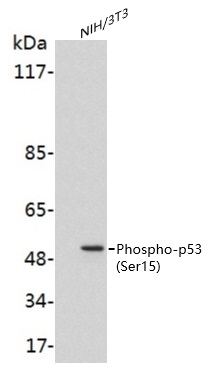 Western blot analysis of extracts on NIH/3T3 cells treated with Etoposide, using Phospho-p53 (Ser15) Rabbit Monoclonal Antibody (EAB21117) at 1:1000 dilution.The lane on the left is blocked with the phospho peptide.
Predicted band size: 44 kDa; Observed band size: 53 kDa |
