

| Host / Isotype | Clonality | Applications | MW (kDa) | Reactivity |
| Mouse IgG1 | Monoclonal | WB, IP, IHC-P, IF/ICC, FC, ELISA | 21 | Human, Mouse, Rat, Pig, Chicken |
| Application Key | WB-Western Blot IP-Immunoprecipitation IHC-Immunohistochemistry IHC-P-Immunohistochemistry-Paraffin |
| Reactivity Key | H-Human M-Mouse R-Rat Mk-Monkey B-Bovine Pg-Pig Hm-Hamster Dg-Dog C-Chicken X-Xenopus Z-Zebrafish |
| Applications Dilutions | |
| The application notes include recommended starting dilutions;optimal dilutions/concentrations should be detemined by the end user. | |
| WB(Westem Blotting) IHC-P(Immunohistochemistry-Paraffin) IF/ICC(Immunofluorescence/Immunocytochemistry) ELISA(Enzyme-linked Immunosorbent Assay) |
WB=1:10000-50000 IP=1:100-500 IHC-P=1:100-500 IF/ICC=1:100-500 FC=1:50-200 |
| Product Information | |
| Conjugate | Unconjugate |
| Specificity | Ras Mouse Monoclonal antibody detects endogenous levels of total K-Ras, H-Ras, and N-Ras proteins. |
| Purification | Affinity purification |
| Concentration | 1mg/ml |
| Format | Liquid |
| Formulation | In PBS, pH 7.4, containing 0.02% sodium azide,0.5% BSA and 50% glycerol. |
| Shipping | Gel Pack |
| Storage | Store at -20°C least 1 year from the date of shipment. avoid repeated freeze/thaw cycles. Aliquots may be stored at +4°C for 1-2 weeks. |
| UniProt ID | |
| Entrez Gene ID | |
| Product Description | |
Ras proteins are critical guanine nucleotide-binding proteins by the c-H-, c-K-, and N-Ras proto-oncogenes. Ras play a pivotal role in cell signaling pathways, influencing cell growth, differentiation, and survival. These proteins are predominantly located at the inner surface of the plasma membrane, where they interact with various effectors to propagate signals from growth factor receptors. The membrane localization is essential for their function, as Ras proteins engage with downstream signaling pathways that regulate cellular responses to external stimuli. Dysregulation of Ras signaling, often due to mutations in the Ras genes, is implicated in numerous cancers, making the study of these proteins vital for understanding tumorigenesis and developing targeted therapies. |
| Product Image Gallery | |
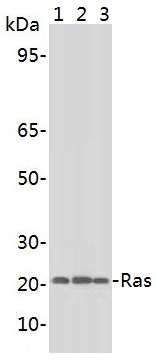 Western blot analysis of extracts on HEK293, Mouse brain, Rat brain cells, using Ras Mouse Monoclonal antibody (EAB21365) at 1:30000 dilution. Secondary antibody Goat Anti-Mouse IgG (H&L)-HRP (EAB21001) at 1:5000 dilution.
|
