

| Host / Isotype | Clonality | Applications | MW (kDa) | Reactivity |
| Rabbit IgG | Monoclonal | WB, IP, IHC-P, IF/ICC | 116 | Human, Mouse, Rat |
| Application Key | WB-Western Blot IP-Immunoprecipitation IHC-Immunohistochemistry IHC-P-Immunohistochemistry-Paraffin |
| Reactivity Key | H-Human M-Mouse R-Rat Mk-Monkey B-Bovine Pg-Pig Hm-Hamster Dg-Dog C-Chicken X-Xenopus Z-Zebrafish |
| Applications Dilutions | |
| The application notes include recommended starting dilutions;optimal dilutions/concentrations should be detemined by the end user. | |
| WB(Westem Blotting) IHC-P(Immunohistochemistry-Paraffin) IF/ICC(Immunofluorescence/Immunocytochemistry) ELISA(Enzyme-linked Immunosorbent Assay) |
WB=1:1000-5000 IP=1:10-100 IHC-P=1:100-500 IF/ICC=1:100-500 |
| Product Information | |
| Conjugate | Unconjugate |
| Specificity | Pyk2 Rabbit Monoclonal Antibody detects endogenous levels of Pyk2 protein. |
| Purification | Affinity purification |
| Concentration | 1mg/ml |
| Format | Liquid |
| Formulation | In PBS, pH 7.4, containing 0.02% sodium azide,0.5% BSA and 50% glycerol. |
| Shipping | Gel Pack |
| Storage | Store at -20°C least 1 year from the date of shipment. avoid repeated freeze/thaw cycles. Aliquots may be stored at +4°C for 1-2 weeks. |
| UniProt ID | |
| Entrez Gene ID | |
| Product Description | |
Pyk2 is a cytoplasmic protein tyrosine kinase which is involved in calcium-induced regulation of ion channels and activation of the map kinase signaling pathway. Pyk2 plays a crucial role in cellular signaling, particularly in the central nervous system, where Pyk2 is highly expressed. Pyk2 is involved in the modulation of ion channel function and the activation of the mitogen-activated protein kinase (MAPK) signaling pathway, which are essential for various cellular processes, including growth, differentiation, and response to stress. The activation of Pyk2 occurs rapidly in response to stimuli that elevate intracellular calcium levels, as well as through the action of phorbol esters that activate protein kinase C (PKC) family members. Notably, Pyk2 undergoes significant post-translational modifications, including phosphorylation on tyrosine residues, which are critical for function and regulation. These modifications not only enhance kinase activity but also facilitate interactions with other signaling proteins, thereby amplifying the cellular response to external signals. |
| Product Image Gallery | |
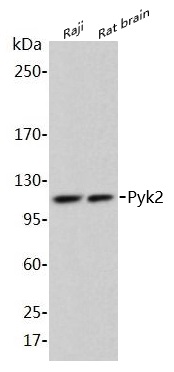 Western blot analysis of extracts on Raji, Rat brain cells, using Pyk2 Rabbit Monoclonal Antibody (EAB22822) at 1:1000 dilution. Secondary antibody Goat Anti-Rabbit IgG (H&L)-HRP (EAB21002) at 1:5000 dilution.
|
