

| Host / Isotype | Clonality | Applications | MW (kDa) | Reactivity |
| Mouse IgG1 | Monoclonal | WB, IP, IF/ICC, ELISA | 36 | Human, Mouse, Rat |
| Application Key | WB-Western Blot IP-Immunoprecipitation IHC-Immunohistochemistry IHC-P-Immunohistochemistry-Paraffin |
| Reactivity Key | H-Human M-Mouse R-Rat Mk-Monkey B-Bovine Pg-Pig Hm-Hamster Dg-Dog C-Chicken X-Xenopus Z-Zebrafish |
| Applications Dilutions | |
| The application notes include recommended starting dilutions;optimal dilutions/concentrations should be detemined by the end user. | |
| WB(Westem Blotting) IHC-P(Immunohistochemistry-Paraffin) IF/ICC(Immunofluorescence/Immunocytochemistry) ELISA(Enzyme-linked Immunosorbent Assay) |
WB=1:5000-20000 IP=1:500-2000 IF/ICC=1:200-1000 |
| Product Information | |
| Conjugate | Unconjugate |
| Specificity | EIF2S1/eIF2α Mouse Monoclonal Antibody detects endogenous levels of EIF2S1/eIF2α protein. |
| Purification | Affinity purification |
| Concentration | 1mg/ml |
| Format | Liquid |
| Formulation | In PBS, pH 7.4, containing 0.02% sodium azide,0.5% BSA and 50% glycerol. |
| Shipping | Gel Pack |
| Storage | Store at -20°C least 1 year from the date of shipment. avoid repeated freeze/thaw cycles. Aliquots may be stored at +4°C for 1-2 weeks. |
| UniProt ID | |
| Entrez Gene ID | |
| Product Description | |
eIF2α also known as EIF2S1, EIF2 is a pivotal component of the eukaryotic initiation complex that regulates the initiation of protein synthesis. Located predominantly in the cytoplasm, eIF2α binds GTP and initiator methionyl-tRNA to form a ternary complex, which associates with the 40S ribosomal subunit to facilitate the assembly of the 80S ribosome. This process is essential for the accurate translation of mRNA into proteins. The phosphorylation state of eIF2α is a critical regulatory point. Unphosphorylated eIF2α promotes normal protein synthesis, while phosphorylation at Ser51 in response to cellular stress inhibits GDP/GTP exchange, leading to a reduction in global protein synthesis. This regulatory mechanism allows cells to adapt to stress conditions such as nutrient deprivation, viral infection, and endoplasmic reticulum stress by conserving resources and preventing the accumulation of misfolded proteins. |
| Product Image Gallery | |
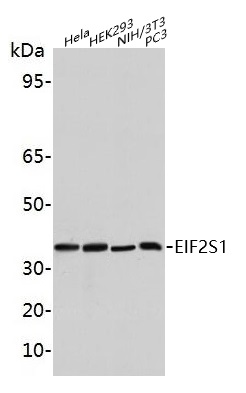 Western blot analysis of extracts on Hela, HEK293, NIH/3T3, PC3 cells, using EIF2S1/eIF2α Mouse Monoclonal Antibody (EAB21951) at 1:10000 dilution. Secondary antibody Goat Anti-Mouse IgG (H&L)-HRP (EAB21001) at 1:5000 dilution.
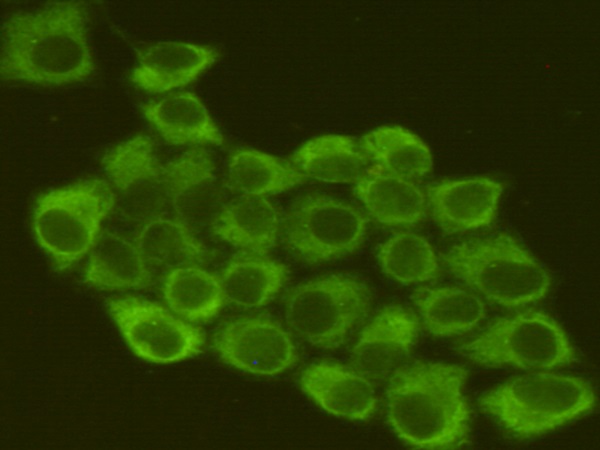 Immunofluorescence analysis of Hela cell, using EIF2S1/eIF2α Mouse Monoclonal Antibody (EAB21951) at 1:500 dilution.
|
