

| Host / Isotype | Clonality | Applications | MW (kDa) | Reactivity |
| Mouse IgG2b | Monoclonal | WB, IHC-P, IF/ICC | 53 | Human, Mouse, Rat |
| Application Key | WB-Western Blot IP-Immunoprecipitation IHC-Immunohistochemistry IHC-P-Immunohistochemistry-Paraffin |
| Reactivity Key | H-Human M-Mouse R-Rat Mk-Monkey B-Bovine Pg-Pig Hm-Hamster Dg-Dog C-Chicken X-Xenopus Z-Zebrafish |
| Applications Dilutions | |
| The application notes include recommended starting dilutions;optimal dilutions/concentrations should be detemined by the end user. | |
| WB(Westem Blotting) IHC-P(Immunohistochemistry-Paraffin) IF/ICC(Immunofluorescence/Immunocytochemistry) ELISA(Enzyme-linked Immunosorbent Assay) |
WB=1:500-2000 IHC-P=1:50-300 IF/ICC=1:50-300 |
| Product Information | |
| Conjugate | Unconjugate |
| Specificity | ETEA/UBXD8 Mouse Monoclonal Antibody detects endogenous levels of ETEA/UBXD8 protein. |
| Purification | Affinity purification |
| Concentration | 1mg/ml |
| Format | Liquid |
| Formulation | In PBS, pH 7.4, containing 0.02% sodium azide,0.5% BSA and 50% glycerol. |
| Shipping | Gel Pack |
| Storage | Store at -20°C least 1 year from the date of shipment. avoid repeated freeze/thaw cycles. Aliquots may be stored at +4°C for 1-2 weeks. |
| UniProt ID | |
| Entrez Gene ID | |
| Product Description | |
ETEA also designated FAF2, UBX domain-containing protein 8 (UBXD8) is a 445-amino acid protein associated with atopic dermatitis (AD), a chronic noncontagious relapsing inflammatory skin disease characterized by eczematous skin lesions and also referred to as eczematous dermatitis. Other atopic diseases such as hay fever, asthma and conjunctivitis often occur along with AD. ETEA shows higher expression in T cells and eosinophils of patients with AD than in T cells and eosinophils of unaffected individuals. T cells are influential in the regulation of the inflammatory process of this disease. The persistence of AD is attributed to dysregulated apoptosis in T cells, eosinophils, and keratinocytes. ETEA may be involved in the resistance to apoptosis in T cells and eosinophils of AD patients. |
| Product Image Gallery | |
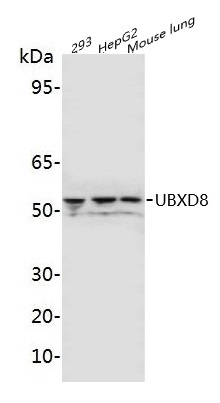 Western blot analysis of extracts on 293, HepG2, Mouse lung cells, using ETEA/UBXD8 Mouse Monoclonal Antibody (EAB22745) at 1:1000 dilution. Secondary antibody Goat Anti-Mouse IgG (H&L)-HRP (EAB21001) at 1:5000 dilution.
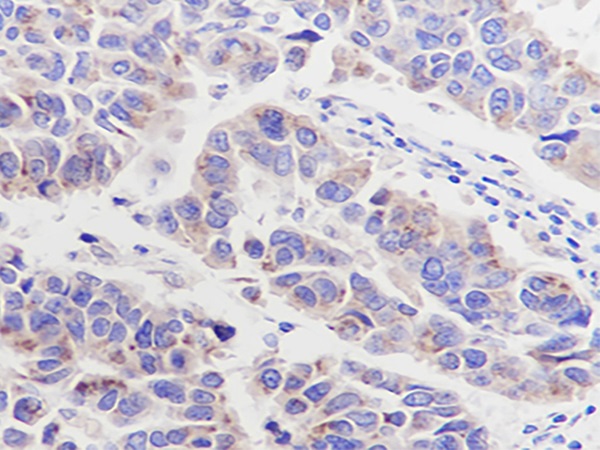 Immunohistochemical analysis of paraffin-embedded Human breast cancer tissue, using ETEA/UBXD8 Mouse Monoclonal Antibody (EAB22745) at 1:100 dilution.
|
