

| Host / Isotype | Clonality | Applications | MW (kDa) | Reactivity |
| Mouse IgG2a | Monoclonal | WB, IHC-P, IF/ICC, ELISA | 37 | Human, Mouse, Rat, Pig |
| Application Key | WB-Western Blot IP-Immunoprecipitation IHC-Immunohistochemistry IHC-P-Immunohistochemistry-Paraffin |
| Reactivity Key | H-Human M-Mouse R-Rat Mk-Monkey B-Bovine Pg-Pig Hm-Hamster Dg-Dog C-Chicken X-Xenopus Z-Zebrafish |
| Applications Dilutions | |
| The application notes include recommended starting dilutions;optimal dilutions/concentrations should be detemined by the end user. | |
| WB(Westem Blotting) IHC-P(Immunohistochemistry-Paraffin) IF/ICC(Immunofluorescence/Immunocytochemistry) ELISA(Enzyme-linked Immunosorbent Assay) |
WB=1:5000-20000 IHC-P=1:500-2000 IF/ICC=1:200-1000 |
| Product Information | |
| Conjugate | Unconjugate |
| Specificity | FBP1 Mouse Monoclonal Antibody detects endogenous levels of FBP1 protein. |
| Purification | Affinity purification |
| Concentration | 1mg/ml |
| Format | Liquid |
| Formulation | In PBS, pH 7.4, containing 0.02% sodium azide,0.5% BSA and 50% glycerol. |
| Shipping | Gel Pack |
| Storage | Store at -20°C least 1 year from the date of shipment. avoid repeated freeze/thaw cycles. Aliquots may be stored at +4°C for 1-2 weeks. |
| UniProt ID | |
| Entrez Gene ID | |
| Product Description | |
FBP1 also known as FBPase 1 is a member of the FBPase Class I family of enzymes. FBP1 plays a crucial role in regulating the expression of the c-Myc gene, which is essential for cell proliferation and growth. FBP1 is primarily located in the nucleus, where FBP1 binds to the far upstream element (FUSE) of the c-Myc gene, facilitating transcription in undifferentiated cells. This nuclear localization enables FBP1 to act as a growth-dependent regulator, ensuring that c-Myc expression is tightly controlled during cellular growth and differentiation. FBP1 expression significantly reduces following cellular differentiation, highlighting FBP1′s importance in maintaining the proliferative state of cells. The FBP family, including FBP1, FBP2, and FBP3, consists of single-stranded DNA-binding proteins that share a conserved central DNA-binding domain, underscoring their functional similarities in gene regulation. |
| Product Image Gallery | |
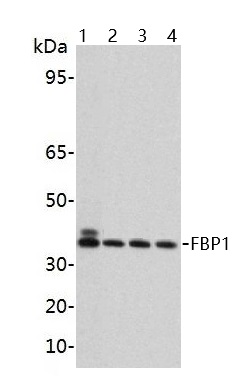 Western blot analysis of extracts on MCF7, T47D, Mouse liver, Rat liver cells, using FBP1 Mouse Monoclonal Antibody (EAB22533) at 1:10000 dilution. Secondary antibody Goat Anti-Mouse IgG (H&L)-HRP (EAB21001) at 1:5000 dilution.
|
