

| Host / Isotype | Clonality | Applications | MW (kDa) | Reactivity |
| Rabbit IgG | Polyclonal | WB, IHC-P, IF/ICC, ELISA | 270 | Human, Mouse, Rat |
| Application Key | WB-Western Blot IP-Immunoprecipitation IHC-Immunohistochemistry IHC-P-Immunohistochemistry-Paraffin |
| Reactivity Key | H-Human M-Mouse R-Rat Mk-Monkey B-Bovine Pg-Pig Hm-Hamster Dg-Dog C-Chicken X-Xenopus Z-Zebrafish |
| Applications Dilutions | |
| The application notes include recommended starting dilutions;optimal dilutions/concentrations should be detemined by the end user. | |
| WB(Westem Blotting) IHC-P(Immunohistochemistry-Paraffin) IF/ICC(Immunofluorescence/Immunocytochemistry) ELISA(Enzyme-linked Immunosorbent Assay) |
WB=1:500-2000 IHC-P=1:50-300 IF/ICC=1:50-300 |
| Product Information | |
| Conjugate | Unconjugate |
| Specificity | SMRT Rabbit Polyclonal Antibody detects endogenous levels of SMRT protein. |
| Purification | Affinity purification |
| Concentration | 1mg/ml |
| Format | Liquid |
| Formulation | In PBS, pH 7.4, containing 0.02% sodium azide,0.5% BSA and 50% glycerol. |
| Shipping | Gel Pack |
| Storage | Store at -20°C least 1 year from the date of shipment. avoid repeated freeze/thaw cycles. Aliquots may be stored at +4°C for 1-2 weeks. |
| UniProt ID | |
| Entrez Gene ID | |
| Product Description | |
SMRT also known as TNRC14, TRAC, NCOR2is a member of a family of thyroid hormone- and retinoic acid receptor-associated co-repressors. SMRT is a nuclear receptor co-repressor that mediates transcriptional silencing of certain target genes. SMRT acts as part of a multisubunit complex which includes histone deacetylases to modify chromatin structure that prevents basal transcriptional activity of target genes. Aberrant expression of this gene is associated with certain cancers. SMRT plays a crucial role in gene expression regulation by acting as a transcriptional repressor. SMRT recognizes a protein that interacts with retinoic acid receptors (RARs) and thyroid hormone receptors (TRs) in their unliganded state, effectively silencing target genes until ligand binding occurs, which releases SMRT and allows for transcriptional activation. |
| Product Image Gallery | |
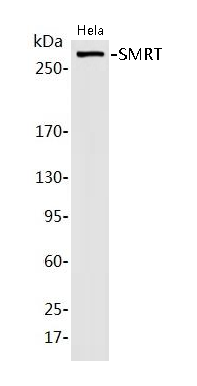 Western blot analysis of extracts on Hela cells, using SMRT Rabbit Polyclonal Antibody (EAB11093) at 1:1000 dilution. Secondary antibody Goat Anti-Rabbit IgG (H&L)-HRP (EAB21002) at 1:5000 dilution.
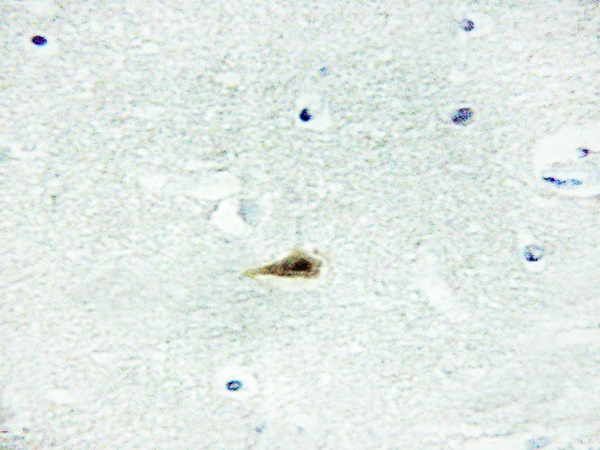 Immunohistochemistry analysis of paraffin-embedded Human brain tissue, using SMRT Rabbit Polyclonal Antibody (EAB11093) at 1:100 dilution.
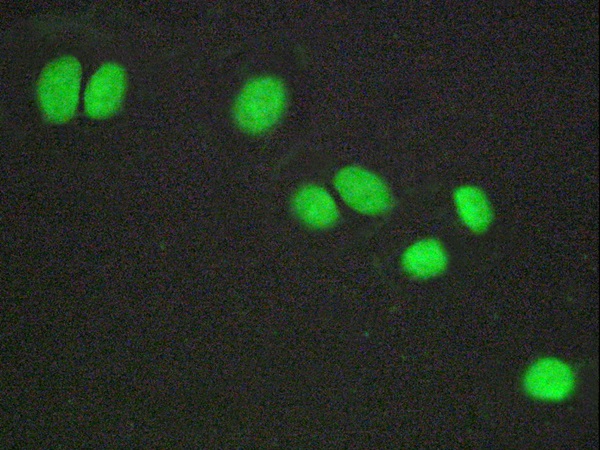 Immunofluorescence analysis of A549 cell, using SMRT Rabbit Polyclonal Antibody (EAB11093) at 1:200 dilution.
|
