

| Host / Isotype | Clonality | Applications | MW (kDa) | Reactivity |
| Mouse IgG1 | Monoclonal | WB, IHC-P, IF/ICC, FC, ELISA | 41 | Human, Mouse, Rat |
| Application Key | WB-Western Blot IP-Immunoprecipitation IHC-Immunohistochemistry IHC-P-Immunohistochemistry-Paraffin |
| Reactivity Key | H-Human M-Mouse R-Rat Mk-Monkey B-Bovine Pg-Pig Hm-Hamster Dg-Dog C-Chicken X-Xenopus Z-Zebrafish |
| Applications Dilutions | |
| The application notes include recommended starting dilutions;optimal dilutions/concentrations should be detemined by the end user. | |
| WB(Westem Blotting) IHC-P(Immunohistochemistry-Paraffin) IF/ICC(Immunofluorescence/Immunocytochemistry) ELISA(Enzyme-linked Immunosorbent Assay) |
WB=1:5000-20000 IHC-P=1:100-500 IF/ICC=1:100-500 FC=1:100-500 |
| Product Information | |
| Conjugate | Unconjugate |
| Specificity | ADK Mouse Monoclonal Antibody detects endogenous levels of ADK protein. |
| Purification | Affinity purification |
| Concentration | 1mg/ml |
| Format | Liquid |
| Formulation | In PBS, pH 7.4, containing 0.02% sodium azide,0.5% BSA and 50% glycerol. |
| Shipping | Gel Pack |
| Storage | Store at -20°C least 1 year from the date of shipment. avoid repeated freeze/thaw cycles. Aliquots may be stored at +4°C for 1-2 weeks. |
| UniProt ID | |
| Entrez Gene ID | |
| Product Description | |
ADK also known as AK is an enzyme which catalyzes the transfer of the gamma-phosphate from ATP to adenosine, thereby serving as a regulator of concentrations of both extracellular adenosine and intracellular adenine nucleotides. ADK plays a crucial role in cellular metabolism by catalyzing the transfer of the gamma-phosphate from ATP to adenosine, thereby regulating the levels of extracellular adenosine and intracellular adenine nucleotides. This regulation is particularly important as adenosine acts as a signaling molecule that influences various physiological processes, including cardiovascular function, neuronal activity, and immune responses. Elevated levels of adenosine are often observed in tissues undergoing injury or inflammation, where adenosine serves to modulate the inflammatory response and protect against excessive neuronal excitability, making ADK a key player in maintaining homeostasis. |
| Product Image Gallery | |
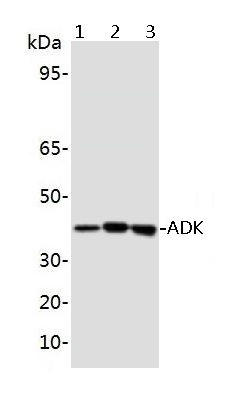 Western blot analysis of extracts on Hela, NIH/3T3, Raw264.7 cells, using ADK Mouse Monoclonal Antibody (EAB22561) at 1:1000 dilution. Secondary antibody Goat Anti-Mouse IgG (H&L)-HRP (EAB21001) at 1:5000 dilution.
|
