

| Host / Isotype | Clonality | Applications | MW (kDa) | Reactivity |
| Mouse IgG1 | Monoclonal | WB, IHC-P, IF/ICC, ELISA | 23 | Human |
| Application Key | WB-Western Blot IP-Immunoprecipitation IHC-Immunohistochemistry IHC-P-Immunohistochemistry-Paraffin |
| Reactivity Key | H-Human M-Mouse R-Rat Mk-Monkey B-Bovine Pg-Pig Hm-Hamster Dg-Dog C-Chicken X-Xenopus Z-Zebrafish |
| Applications Dilutions | |
| The application notes include recommended starting dilutions;optimal dilutions/concentrations should be detemined by the end user. | |
| WB(Westem Blotting) IHC-P(Immunohistochemistry-Paraffin) IF/ICC(Immunofluorescence/Immunocytochemistry) ELISA(Enzyme-linked Immunosorbent Assay) |
WB=1:500-2000 IHC-P=1:100-500 IF/ICC=1:100-500 |
| Product Information | |
| Conjugate | Unconjugate |
| Specificity | CD3ε Mouse Monoclonal Antibody detects endogenous levels of CD3ε protein. |
| Purification | Affinity purification |
| Concentration | 1mg/ml |
| Format | Liquid |
| Formulation | In PBS, pH 7.4, containing 0.02% sodium azide,0.5% BSA and 50% glycerol. |
| Shipping | Gel Pack |
| Storage | Store at -20°C least 1 year from the date of shipment. avoid repeated freeze/thaw cycles. Aliquots may be stored at +4°C for 1-2 weeks. |
| UniProt ID | |
| Entrez Gene ID | |
| Product Description | |
CD3ε also known TCRE, CD3E plays a crucial role in the immune response as a component of the T cell receptor (TCR) complex, which is essential for T cell activation and signaling. Located on the surface of T cells, CD3ε is part of a multisubunit complex that transmits signals upon recognition of foreign antigens, leading to T cell activation and proliferation. This process is vital for the adaptive immune response, allowing the body to effectively respond to pathogens. The CD3 complex consists of several invariant polypeptide chains, including CD3-γ, CD3-δ, and CD3-ζ, which work together to facilitate the signaling cascade initiated by TCR engagement. Notably, the presence of immunoreceptor tyrosine-based activation motifs (ITAMs) within these chains is critical for recruiting signaling molecules, such as ZAP-70, which further propagate the activation signal. |
| Product Image Gallery | |
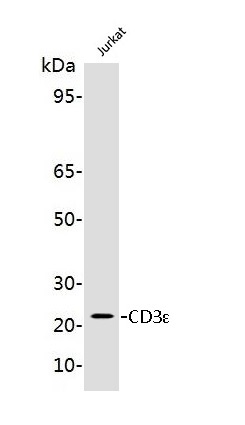 Western blot analysis of extracts on Jurkat cells, using CD3ε Mouse Monoclonal Antibody (EAB21641) at 1:1000 dilution. Secondary antibody Goat Anti-Mouse IgG (H&L)-HRP (EAB21001) at 1:5000 dilution.
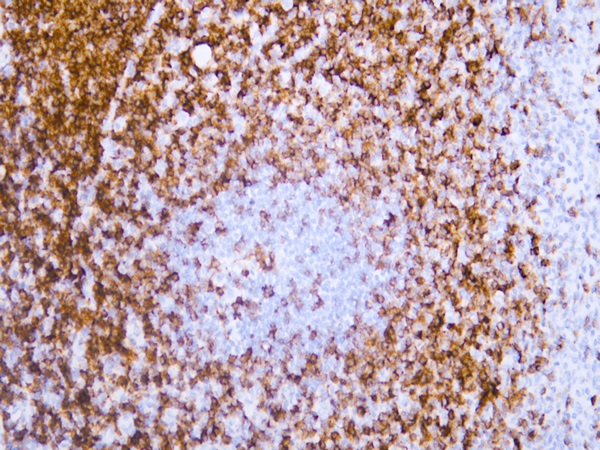 Immunohistochemistry analysis of paraffin-embedded Human tonsil tissue, using CD3ε Mouse Monoclonal Antibody (EAB21641) at 1:200 dilution.
|
