

| Host / Isotype | Clonality | Applications | MW (kDa) | Reactivity |
| Rabbit IgG | Polyclonal | WB, IHC-P, IF/ICC, ELISA | 68 | Human, Mouse, Rat |
| Application Key | WB-Western Blot IP-Immunoprecipitation IHC-Immunohistochemistry IHC-P-Immunohistochemistry-Paraffin |
| Reactivity Key | H-Human M-Mouse R-Rat Mk-Monkey B-Bovine Pg-Pig Hm-Hamster Dg-Dog C-Chicken X-Xenopus Z-Zebrafish |
| Applications Dilutions | |
| The application notes include recommended starting dilutions;optimal dilutions/concentrations should be detemined by the end user. | |
| WB(Westem Blotting) IHC-P(Immunohistochemistry-Paraffin) IF/ICC(Immunofluorescence/Immunocytochemistry) ELISA(Enzyme-linked Immunosorbent Assay) |
WB=1:500-2000 IHC-P=1:50-300 IF/ICC=1:50-300 |
| Product Information | |
| Conjugate | Unconjugate |
| Specificity | Nrf2 Rabbit Polyclonal Antibody detects endogenous levels of Nrf2 protein. |
| Purification | Affinity purification |
| Concentration | 1mg/ml |
| Format | Liquid |
| Formulation | In PBS, pH 7.4, containing 0.02% sodium azide,0.5% BSA and 50% glycerol. |
| Shipping | Gel Pack |
| Storage | Store at -20°C least 1 year from the date of shipment. avoid repeated freeze/thaw cycles. Aliquots may be stored at +4°C for 1-2 weeks. |
| UniProt ID | |
| Entrez Gene ID | |
| Product Description | |
Nrf2 is a key regulator of the cellular response to oxidative stress, plays a crucial role in maintaining cellular homeostasis by activating the expression of antioxidant and detoxifying enzymes. Nrf2 protein is primarily located in the cytoplasm under normal conditions, where Keap1 maintains regulatory control. Upon exposure to oxidative stress or xenobiotics, Nrf2 is released from Keap1 and translocates to the nucleus, where binding to antioxidant response elements (ARE) in the promoter regions of target genes leads to transcriptional activation. This translocation is vital for the cellular defense mechanism against oxidative damage, as Nrf2 enhances the expression of genes involved in detoxification and antioxidant responses, such as NQO1. The Nrf2 pathway is not only essential for protecting cells from oxidative stress but also plays a significant role in various physiological processes, including inflammation and metabolism, making Nrf2 a critical target for therapeutic interventions in diseases associated with oxidative stress and inflammation. |
| Product Image Gallery | |
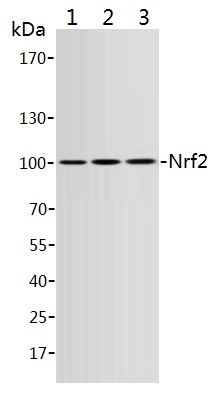 Western blot analysis of extracts on Hela, NIH/3T3, Mouse liver cells, using Nrf2 Rabbit Polyclonal Antibody (EAB13307) at 1:1000 dilution. Secondary antibody Goat Anti-Rabbit IgG (H&L)-HRP (EAB21002) at 1:5000 dilution.
Predicted band size: 68 kDa; Observed band size: 75-100 kDa 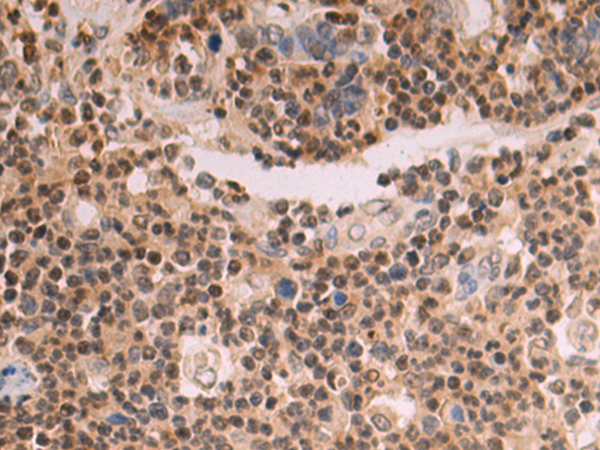 Immunohistochemistry analysis of paraffin-embedded Human gastric cancer tissue, using Nrf2 Rabbit Polyclonal Antibody (EAB13307) at 1:100 dilution.
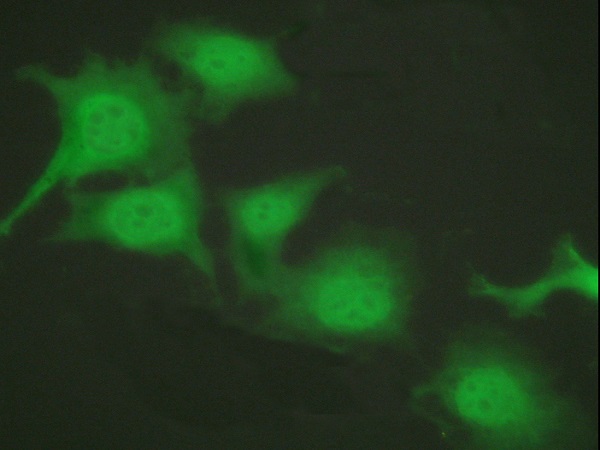 Immunofluorescence analysis of HuvEc cell, using Nrf2 Rabbit Polyclonal Antibody (EAB13307) at 1:200 dilution.
|
