

| Host / Isotype | Clonality | Applications | MW (kDa) | Reactivity |
| Mouse IgG1 | Monoclonal | WB, IHC-P, IF/ICC | 272 | Human, Mouse, Rat |
| Application Key | WB-Western Blot IP-Immunoprecipitation IHC-Immunohistochemistry IF-Immunofluorescence ICC-Immunocytochemistry FC-Flow Cytometry |
| Reactivity Key | H-Human M-Mouse R-Rat Mk-Monkey B-Bovine Pg-Pig Hm-Hamster Dg-Dog C-Chicken X-Xenopus Z-Zebrafish Hr-Horse All-All Species Expected |
| Applications Dilutions | |
| The application notes include recommended starting dilutions;optimal dilutions/concentrations should be detemined by the end user. | |
| WB(Westem Blotting) IHC-P(Immunohistochemistry-Paraffin) IF/ICC(Immunofluorescence/Immunocytochemistry) ELISA(Enzyme-linked Immunosorbent Assay) |
WB=1:1000-5000 IHC-P=1:100-500 IF/ICC=1:100-500 |
| Product Information | |
| Conjugate | Unconjugate |
| Specificity | Fibronectin/FN1 Mouse Monoclonal Antibody detects endogenous levels of Fibronectin/FN1 protein. |
| Purification | Affinity purification |
| Concentration | 1mg/ml |
| Format | Liquid |
| Formulation | In PBS, pH 7.4, containing 0.02% sodium azide,0.5% BSA and 50% glycerol. |
| Shipping | Gel Pack |
| Storage | Store at -20°C least 1 year from the date of shipment. avoid repeated freeze/thaw cycles. Aliquots may be stored at +4°C for 1-2 weeks. |
| UniProt ID | |
| Entrez Gene ID | |
| Product Description | |
Fibronectin also known as FN, FN1 is a crucial extracellular matrix glycoprotein. Fibronectin plays a significant role in cell adhesion, motility, and wound healing, making Fibronectin essential for tissue repair and regeneration. Fibronectin exists as a high molecular weight heterodimer, and Fibronectin′s presence on cell surfaces and in extracellular fluids is vital for maintaining cellular architecture and function. Notably, Fibronectin undergoes post-translational modifications such as glycosylation, which can influence Fibronectin′s interaction with other proteins and functional properties. For instance, glycosylated forms of Fibronectin have been implicated in the formation of the myofibroblast phenotype, particularly in conditions like Dupuytren′s disease, where specific splice variants of Fibronectin are associated with pathological tissue remodeling. |
| Product Image Gallery | |
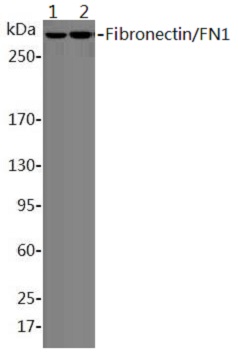 Western blot analysis of extracts on Hela, Rat kidney cells, using Fibronectin/FN1 Mouse Monoclonal Antibody (EAB13607) at 1:2000 dilution. Secondary antibody Goat Anti-Mouse IgG (H&L)-HRP (EAB21001) at 1:5000 dilution.
Predicted band size: 272 kDa; Observed band size: 285 kDa 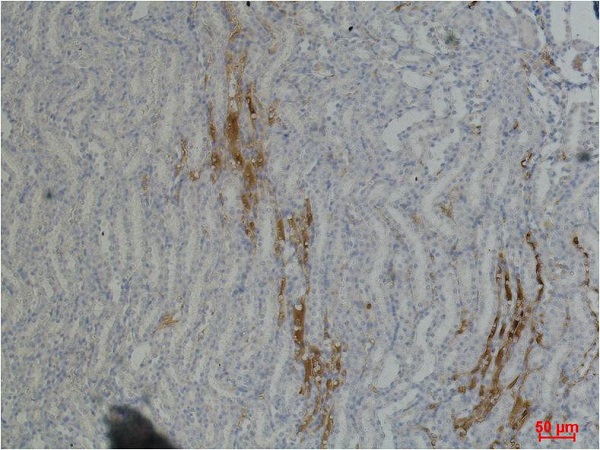 Immunohistochemical analysis of paraffin-embedded Mouse kidney tissue, using Fibronectin/FN1 Mouse Monoclonal Antibody (EAB13607) at 1:500 dilution.
|
