
| Host / Isotype | Clonality | Applications | MW (kDa) | Reactivity |
| Rabbit IgG | Polyclonal | WB, ELISA | 60 | Human, Mouse, Rat |
| Application Key | WB-Western Blot IP-Immunoprecipitation IHC-Immunohistochemistry IF-Immunofluorescence ICC-Immunocytochemistry FC-Flow Cytometry |
| Reactivity Key | H-Human M-Mouse R-Rat Mk-Monkey B-Bovine Pg-Pig Hm-Hamster Dg-Dog C-Chicken X-Xenopus Z-Zebrafish Hr-Horse All-All Species Expected |
| Applications Dilutions | |
| The application notes include recommended starting dilutions;optimal dilutions/concentrations should be detemined by the end user. | |
| WB(Westem Blotting) IHC-P(Immunohistochemistry-Paraffin) IF/ICC(Immunofluorescence/Immunocytochemistry) ELISA(Enzyme-linked Immunosorbent Assay) |
WB=1:500-2000 |
| Product Information | |
| Conjugate | Unconjugate |
| Specificity | EAAT1 Rabbit Polyclonal Antibody detects endogenous levels of EAAT1 protein. |
| Purification | Affinity purification |
| Concentration | 1mg/ml |
| Format | Liquid |
| Formulation | In PBS, pH 7.4, containing 0.02% sodium azide,0.5% BSA and 50% glycerol. |
| Shipping | Gel Pack |
| Storage | Store at -20°C least 1 year from the date of shipment. avoid repeated freeze/thaw cycles. Aliquots may be stored at +4°C for 1-2 weeks. |
| UniProt ID | |
| Entrez Gene ID | |
| Product Description | |
EAAT1 also known as, SLC1A3 is one of the two glial glutamate transporters that clear the extracellular glutamate generated during neuronal signal transmission. EAAT1 plays a crucial role in maintaining synaptic homeostasis by clearing excess extracellular glutamate, a neurotransmitter that, when accumulated, can lead to excitotoxicity and neuronal damage. EAAT1 is primarily located in glial cells and pre-synaptic glutamatergic nerve endings, where EAAT1 facilitates the reuptake of L-glutamate and D-aspartate, thereby terminating the postsynaptic action of these neurotransmitters. This function is vital for preventing overstimulation of neurons and ensuring proper neuronal signaling. Additionally, EAAT1 expression on the cell surface is regulated by insulin-like growth factor 1, which activates phosphatidylinositol-3-kinase, highlighting EAAT1′s importance in both neural and non-neural tissues. |
| Product Image Gallery | |
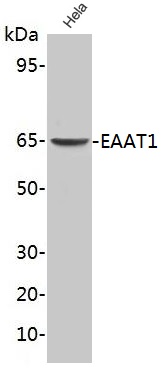 Western blot analysis of extracts on Hela cells, using EAAT1 Rabbit Polyclonal Antibody (EAB13511) at 1:1000 dilution. Secondary antibody Goat Anti-Rabbit IgG (H&L)-HRP (EAB21002) at 1:5000 dilution.
Predicted band size: 60 kDa; Observed band size: 65 kDa |
