

| Host / Isotype | Clonality | Applications | MW (kDa) | Reactivity |
| Rabbit IgG | Polyclonal | WB, IHC-P, IF/ICC, ELISA | 54 | Human, Mouse, Rat |
| Application Key | WB-Western Blot IP-Immunoprecipitation IHC-Immunohistochemistry IF-Immunofluorescence ICC-Immunocytochemistry FC-Flow Cytometry |
| Reactivity Key | H-Human M-Mouse R-Rat Mk-Monkey B-Bovine Pg-Pig Hm-Hamster Dg-Dog C-Chicken X-Xenopus Z-Zebrafish Hr-Horse All-All Species Expected |
| Applications Dilutions | |
| The application notes include recommended starting dilutions;optimal dilutions/concentrations should be detemined by the end user. | |
| WB(Westem Blotting) IHC-P(Immunohistochemistry-Paraffin) IF/ICC(Immunofluorescence/Immunocytochemistry) ELISA(Enzyme-linked Immunosorbent Assay) |
WB=1:500-2000 IHC-P=1:50-300 IF/ICC=1:50-300 |
| Product Information | |
| Conjugate | Unconjugate |
| Specificity | Phospho-MLKL (Ser358) Rabbit Polyclonal Antibody detects endogenous levels of MLKL protein only when phosphoryated at Ser358. |
| Purification | Affinity purification |
| Concentration | 1mg/ml |
| Format | Liquid |
| Formulation | In PBS, pH 7.4, containing 0.02% sodium azide,0.5% BSA and 50% glycerol. |
| Shipping | Gel Pack |
| Storage | Store at -20°C least 1 year from the date of shipment. avoid repeated freeze/thaw cycles. Aliquots may be stored at +4°C for 1-2 weeks. |
| UniProt ID | |
| Entrez Gene ID | |
| Product Description | |
MLKL (mixed lineage kinase domain-like) also known as HMLKL is a 471 amino acid protein that contains one protein kinase domain which is thought to be catalytically inactive. The gene encoding MLKL maps to chromosome 16 and is expressed as two isoforms which are produced by alternative splicing events. Chromosome 16, which is associated with a variety of genetic disorders, encodes over 900 genes and comprises nearly 3% of the human genome. The GAN gene is located on chromosome 16 and, with mutation, may lead to giant axonal neuropathy, a nervous system disorder characterized by increasing malfunction with growth. The rare disorder Rubinstein-Taybi syndrome is associated with chromosome 16, as is Crohn′s disease, which is a gastrointestinal inflammatory condition. |
| Product Image Gallery | |
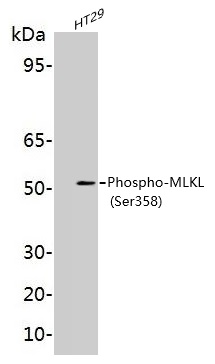 Western blot analysis of extracts on HT29 cells treated with TNFalpha, using Phospho-MLKL (Ser358) Rabbit Polyclonal Antibody (EAB13435) at 1:1000 dilution. The lane on the left is blocked with the phospho peptide.
|
