

| Host / Isotype | Clonality | Applications | MW (kDa) | Reactivity |
| Rabbit IgG | Monoclonal | WB, IP, IHC-P, IF/ICC, FC | 49 | Human, Mouse, Rat |
| Application Key | WB-Western Blot IP-Immunoprecipitation IHC-Immunohistochemistry IF-Immunofluorescence ICC-Immunocytochemistry FC-Flow Cytometry |
| Reactivity Key | H-Human M-Mouse R-Rat Mk-Monkey B-Bovine Pg-Pig Hm-Hamster Dg-Dog C-Chicken X-Xenopus Z-Zebrafish Hr-Horse All-All Species Expected |
| Applications Dilutions | |
| The application notes include recommended starting dilutions;optimal dilutions/concentrations should be detemined by the end user. | |
| WB(Westem Blotting) IHC-P(Immunohistochemistry-Paraffin) IF/ICC(Immunofluorescence/Immunocytochemistry) ELISA(Enzyme-linked Immunosorbent Assay) |
WB=1:500-2000 IHC-P=1:50-300 IF/ICC=1:50-300 |
| Product Information | |
| Conjugate | Unconjugate |
| Specificity | SMYD3 Rabbit Monoclonal Antibody detects endogenous levels of SMYD3 protein. |
| Purification | Affinity purification |
| Concentration | 1mg/ml |
| Format | Liquid |
| Formulation | In PBS, pH 7.4, containing 0.02% sodium azide,0.5% BSA and 50% glycerol. |
| Shipping | Gel Pack |
| Storage | Store at -20°C least 1 year from the date of shipment. avoid repeated freeze/thaw cycles. Aliquots may be stored at +4°C for 1-2 weeks. |
| UniProt ID | |
| Entrez Gene ID | |
| Product Description | |
SMYD3(SET and MYND domain-containing 3) is a histone methyltransferase which functions in RNA polymerase II complexes by an interaction with a specific RNA helicase. SMYD3 is responsible for the methylation of Lys-4 on Histone H3, a modification that serves as a specific marker for epigenetic transcriptional activation, thereby influencing gene expression patterns essential for cellular function and development. SMYD3 features an N-terminal MYND-type zinc finger domain followed by a SET domain, which is integral to methyltransferase activity. Additionally, the presence of heat shock protein HSP 90A significantly enhances SMYD3 methyltransferase activity, highlighting the importance of protein interactions in regulating function. SMYD3 is predominantly expressed in testis and skeletal muscle tissues and is found to be over-expressed in a majority of colorectal carcinomas, hepatocellular carcinomas, and breast carcinomas, making SMYD3 a potential target for therapeutic intervention in cancer treatment. |
| Product Image Gallery | |
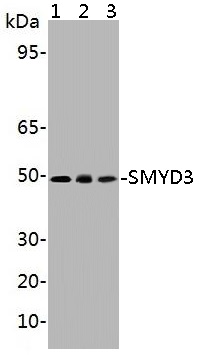 Western blot analysis of extracts on Hela, MCF7, K562, Mouse spleen cells, using SMYD3 Rabbit Monoclonal Antibody (EAB22280) at 1:1000 dilution. Secondary antibody Goat Anti-Rabbit IgG (H&L)-HRP (EAB21002) at 1:5000 dilution.
Predicted band size: 49 kDa; Observed band size: 42 kDa |
