

| Host / Isotype | Clonality | Applications | MW (kDa) | Reactivity |
| Mouse IgG1 | Monoclonal | WB, IF/ICC, FC, ELISA | 16 | Human, Mouse |
| Application Key | WB-Western Blot IP-Immunoprecipitation IHC-Immunohistochemistry IF-Immunofluorescence ICC-Immunocytochemistry FC-Flow Cytometry |
| Reactivity Key | H-Human M-Mouse R-Rat Mk-Monkey B-Bovine Pg-Pig Hm-Hamster Dg-Dog C-Chicken X-Xenopus Z-Zebrafish Hr-Horse All-All Species Expected |
| Applications Dilutions | |
| The application notes include recommended starting dilutions;optimal dilutions/concentrations should be detemined by the end user. | |
| WB(Westem Blotting) IHC-P(Immunohistochemistry-Paraffin) IF/ICC(Immunofluorescence/Immunocytochemistry) ELISA(Enzyme-linked Immunosorbent Assay) |
WB=1:500-2000 IF/ICC=1:100-500 FC=1:50-200 |
| Product Information | |
| Conjugate | Unconjugate |
| Specificity | SOD1 Mouse Monoclonal Antibody detects endogenous levels of SOD1 protein. |
| Purification | Affinity purification |
| Concentration | 1mg/ml |
| Format | Liquid |
| Formulation | In PBS, pH 7.4, containing 0.02% sodium azide,0.5% BSA and 50% glycerol. |
| Shipping | Gel Pack |
| Storage | Store at -20°C least 1 year from the date of shipment. avoid repeated freeze/thaw cycles. Aliquots may be stored at +4°C for 1-2 weeks. |
| UniProt ID | |
| Entrez Gene ID | |
| Product Description | |
SOD1(Superoxide dismutase 1) is one of two isozymes responsible for destroying free superoxide radicals in the body.SOD1 plays a crucial role in cellular defense against oxidative stress by catalyzing the dismutation of superoxide radicals into hydrogen peroxide and molecular oxygen, thereby protecting cells from damage caused by reactive oxygen species. This enzymatic activity is vital for maintaining cellular homeostasis, particularly in tissues with high metabolic rates, such as the brain and muscles. SOD1 is predominantly located in the cytosol and functions as a homodimer, which is essential for stability and activity. Mutations in the SOD1 gene have been linked to severe neurological disorders, including amyotrophic lateral sclerosis (ALS), where the loss of antioxidant function leads to increased oxidative damage and neurodegeneration. |
| Product Image Gallery | |
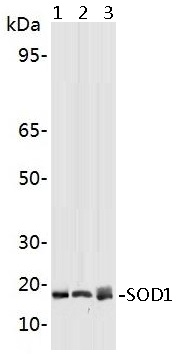 Western blot analysis of extracts on Hela, A431, NIH/3T3 cells, using SOD1 Mouse Monoclonal Antibody (EAB22135) at 1:1000 dilution. Secondary antibody Goat Anti-Mouse IgG (H&L)-HRP (EAB21001) at 1:5000 dilution.
|
