

| Host / Isotype | Clonality | Applications | MW (kDa) | Reactivity |
| Mouse IgG1 | Monoclonal | WB, IF/ICC, FC, ELISA | 198 | Human, Monkey |
| Application Key | WB-Western Blot IP-Immunoprecipitation IHC-Immunohistochemistry IF-Immunofluorescence ICC-Immunocytochemistry FC-Flow Cytometry |
| Reactivity Key | H-Human M-Mouse R-Rat Mk-Monkey B-Bovine Pg-Pig Hm-Hamster Dg-Dog C-Chicken X-Xenopus Z-Zebrafish Hr-Horse All-All Species Expected |
| Applications Dilutions | |
| The application notes include recommended starting dilutions;optimal dilutions/concentrations should be detemined by the end user. | |
| WB(Westem Blotting) IHC-P(Immunohistochemistry-Paraffin) IF/ICC(Immunofluorescence/Immunocytochemistry) ELISA(Enzyme-linked Immunosorbent Assay) |
WB=1:500-2000 IF/ICC=1:100-500 FC=1:50-200 |
| Product Information | |
| Conjugate | Unconjugate |
| Specificity | NUP98 Mouse Monoclonal Antibody detects endogenous levels of NUP98 protein. |
| Purification | Affinity purification |
| Concentration | 1mg/ml |
| Format | Liquid |
| Formulation | In PBS, pH 7.4, containing 0.02% sodium azide,0.5% BSA and 50% glycerol. |
| Shipping | Gel Pack |
| Storage | Store at -20°C least 1 year from the date of shipment. avoid repeated freeze/thaw cycles. Aliquots may be stored at +4°C for 1-2 weeks. |
| UniProt ID | |
| Entrez Gene ID | |
| Product Description | |
NUP98 belongs to the nucleoporin gene family and encodes a 186 kDa precursor protein that undergoes autoproteolytic cleavage to generate a 98 kDa nucleoporin and 96 kDa nucleoporin. The 98 kDa nucleoporin contains a Gly-Leu-Phe-Gly (GLGF) repeat domain and participates in many cellular processes, including nuclear import, nuclear export, mitotic progression, and regulation of gene expression. The 96 kDa nucleoporin is a scaffold component of the NPC. Proteolytic cleavage is important for targeting of the proteins to the NPC. Translocations between this gene and many other partner genes have been observed in different leukemias. Rearrangements typically result in chimeras with the N-terminal GLGF domain of this gene to the C-terminus of the partner gene. Alternative splicing results in multiple transcript variants encoding different isoforms, at least two of which are proteolytically processed. |
| Product Image Gallery | |
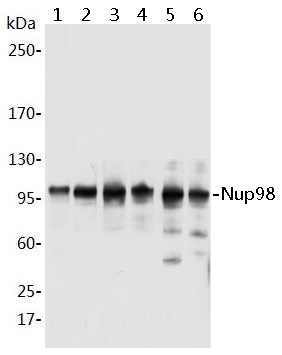 Western blot analysis of extracts on Hela, HT29, HL60, Jurkat, A431, LO2 cells, using NUP98 Mouse Monoclonal Antibody (EAB22069) at 1:1000 dilution. Secondary antibody Goat Anti-Rabbit IgG (H&L)-HRP (EAB21002) at 1:5000 dilution.
Predicted band size: 198 kDa; Observed band size: 98 kDa |
