

| Host / Isotype | Clonality | Applications | MW (kDa) | Reactivity |
| Rabbit IgG | Monoclonal | WB, IP, IHC-P, IF/ICC | 56 | Human, Mouse, Rat |
| Application Key | WB-Western Blot IP-Immunoprecipitation IHC-Immunohistochemistry IF-Immunofluorescence ICC-Immunocytochemistry FC-Flow Cytometry |
| Reactivity Key | H-Human M-Mouse R-Rat Mk-Monkey B-Bovine Pg-Pig Hm-Hamster Dg-Dog C-Chicken X-Xenopus Z-Zebrafish Hr-Horse All-All Species Expected |
| Applications Dilutions | |
| The application notes include recommended starting dilutions;optimal dilutions/concentrations should be detemined by the end user. | |
| WB(Westem Blotting) IHC-P(Immunohistochemistry-Paraffin) IF/ICC(Immunofluorescence/Immunocytochemistry) ELISA(Enzyme-linked Immunosorbent Assay) |
WB=1:500-2000 IP=1:10-100 IHC-P=1:50-200 IF/ICC=1:50-200 |
| Product Information | |
| Conjugate | Unconjugate |
| Specificity | TRAF2 Rabbit Monoclonal Antibody detects endogenous levels of TRAF2 protein. |
| Purification | Affinity purification |
| Concentration | 1mg/ml |
| Format | Liquid |
| Formulation | In PBS, pH 7.4, containing 0.02% sodium azide,0.5% BSA and 50% glycerol. |
| Shipping | Gel Pack |
| Storage | Store at -20°C least 1 year from the date of shipment. avoid repeated freeze/thaw cycles. Aliquots may be stored at +4°C for 1-2 weeks. |
| UniProt ID | |
| Entrez Gene ID | |
| Product Description | |
TRAF2(TNF receptor associated factor 2) is a member of the TNF receptor associated factor (TRAF) protein family. TRAF2 plays a crucial role in mediating tumor necrosis factor (TNF) receptor signaling, particularly through interaction with TNF receptor 1 (TNF-R1) and TNF-R2, which are integral to the TNF receptor superfamily. TRAF2 is primarily located in the cytoplasm, where TRAF2 forms heterodimeric complexes with TRAF1 and other signaling molecules, facilitating the transmission of signals that regulate various cellular processes, including inflammation and apoptosis. Proper functioning of TRAF2 is vital for maintaining immune responses and cellular homeostasis, as dysregulation of this signaling pathway can lead to pathological conditions such as autoimmune diseases and cancer. |
| Product Image Gallery | |
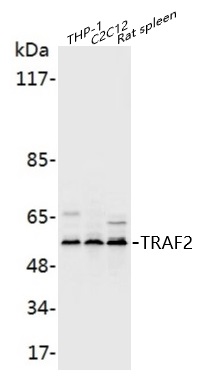 Western blot analysis of extracts on THP-1, C2C12, Rat spleen cells, using TRAF2 Rabbit Monoclonal Antibody (EAB23002) at 1:1000 dilution. Secondary antibody Goat Anti-Rabbit IgG (H&L)-HRP (EAB21002) at 1:5000 dilution.
|
