

| Host / Isotype | Clonality | Applications | MW (kDa) | Reactivity |
| Mouse IgG1 | Monoclonal | WB, IHC-P, IF/ICC, FC, ELISA | 244 | Human |
| Application Key | WB-Western Blot IP-Immunoprecipitation IHC-Immunohistochemistry IF-Immunofluorescence ICC-Immunocytochemistry FC-Flow Cytometry |
| Reactivity Key | H-Human M-Mouse R-Rat Mk-Monkey B-Bovine Pg-Pig Hm-Hamster Dg-Dog C-Chicken X-Xenopus Z-Zebrafish Hr-Horse All-All Species Expected |
| Applications Dilutions | |
| The application notes include recommended starting dilutions;optimal dilutions/concentrations should be detemined by the end user. | |
| WB(Westem Blotting) IHC-P(Immunohistochemistry-Paraffin) IF/ICC(Immunofluorescence/Immunocytochemistry) ELISA(Enzyme-linked Immunosorbent Assay) |
WB=1:500-2000 IHC-P=1:100-500 IF/ICC=1:100-500 FC=1:50-200 |
| Product Information | |
| Conjugate | Unconjugate |
| Specificity | APC2 Mouse Monoclonal Antibody detects endogenous levels of APC protein. |
| Purification | Affinity purification |
| Concentration | 1mg/ml |
| Format | Liquid |
| Formulation | In PBS, pH 7.4, containing 0.02% sodium azide,0.5% BSA and 50% glycerol. |
| Shipping | Gel Pack |
| Storage | Store at -20°C least 1 year from the date of shipment. avoid repeated freeze/thaw cycles. Aliquots may be stored at +4°C for 1-2 weeks. |
| UniProt ID | |
| Entrez Gene ID | |
| Product Description | |
APC2 also known as APCL is a strongly conserved protein that has an N-terminal coiled-coil domain followed by an armadillo domain, five 20-amino acid repeats, and two SAMP domains. APC2 promotes the assembly of a multiprotein complex that recruits and phosphorylates the Wnt effector beta-catenin and targets beta-catenin for ubiquitylation and proteasomal degradation. APC2 therefore plays a role in the reduction of cytoplasmic levels of beta-catenin which in turn reduces activation of Wnt target genes that play a pivotal role in the pathogenesis of various human cancers. APC2 is closely related to the adenomatous polyposis coli (APC) tumor-suppressor protein and has similar tumor-suppressor effects. APC2 also plays a role in actin assembly, cell-cell adhesion, and microtubule network formation through its interaction with cytoskeletal proteins. |
| Product Image Gallery | |
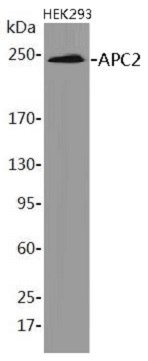 Western blot analysis of extracts on HEK293 cells, using APC2 Mouse Monoclonal Antibody (EAB21657) at 1:1000 dilution. Secondary antibody Goat Anti-Mouse IgG (H&L)-HRP (EAB21001) at 1:5000 dilution.
|
