

| Host / Isotype | Clonality | Applications | MW (kDa) | Reactivity |
| Rabbit IgG | Monoclonal | WB, IHC-P | 17 | Human, Mouse, Rat |
| Application Key | WB-Western Blot IP-Immunoprecipitation IHC-Immunohistochemistry IF-Immunofluorescence ICC-Immunocytochemistry FC-Flow Cytometry |
| Reactivity Key | H-Human M-Mouse R-Rat Mk-Monkey B-Bovine Pg-Pig Hm-Hamster Dg-Dog C-Chicken X-Xenopus Z-Zebrafish Hr-Horse All-All Species Expected |
| Applications Dilutions | |
| The application notes include recommended starting dilutions;optimal dilutions/concentrations should be detemined by the end user. | |
| WB(Westem Blotting) IHC-P(Immunohistochemistry-Paraffin) IF/ICC(Immunofluorescence/Immunocytochemistry) ELISA(Enzyme-linked Immunosorbent Assay) |
WB=1:500-2000 IHC-P=1:50-200 |
| Product Information | |
| Conjugate | Unconjugate |
| Specificity | DNAJC15 Rabbit Monoclonal Antibody detects endogenous levels of DNAJC15 protein. |
| Purification | Affinity purification |
| Concentration | 1mg/ml |
| Format | Liquid |
| Formulation | In PBS, pH 7.4, containing 0.02% sodium azide,0.5% BSA and 50% glycerol. |
| Shipping | Gel Pack |
| Storage | Store at -20°C least 1 year from the date of shipment. avoid repeated freeze/thaw cycles. Aliquots may be stored at +4°C for 1-2 weeks. |
| UniProt ID | |
| Entrez Gene ID | |
| Product Description | |
DNAJC15 also known as HSD18, DNAJD1, MCJ is a 150 amino acid ubiquitously expressed single-pass membrane protein containing one J domain. Localizing to the golgi apparatus and only present in vertebrates, DNAJC15 may be associated with increased chemotherapeutic resistance in ovarian cancer by inducing expression of the Mdr drug transporter and preventing intracellular drug accumulation. The DnaJ family is one of the largest of all the chaperone families and has evolved with diverse cellular localization and functions. The presence of a J domain defines a protein as a member of the DnaJ family. DnaJ heat shock induced proteins are from the bacterium Escherichia coli and are under the control of the htpR regulatory protein. The DnaJ proteins play a critical role in the HSP 70 chaperone machine by interacting with HSP 70 to stimulate ATP hydrolysis. DnaJ proteins are important mediators of proteolysis and are involved in the regulation of protein degradation, exocytosis and endocytosis. |
| Product Image Gallery | |
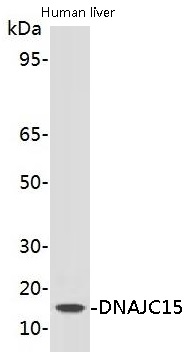 Western blot analysis of extracts on Human liver cells, using DNAJC15 Rabbit Monoclonal Antibody (EAB21468) at 1:1000 dilution. Secondary antibody Goat Anti-Rabbit IgG (H&L)-HRP (EAB21002) at 1:10000 dilution.
|
