

| Host / Isotype | Clonality | Applications | MW (kDa) | Reactivity |
| Rabbit IgG | Monoclonal | WB, IP, IHC-P, IF/ICC | 84 | Human, Mouse |
| Application Key | WB-Western Blot IP-Immunoprecipitation IHC-Immunohistochemistry IF-Immunofluorescence ICC-Immunocytochemistry FC-Flow Cytometry |
| Reactivity Key | H-Human M-Mouse R-Rat Mk-Monkey B-Bovine Pg-Pig Hm-Hamster Dg-Dog C-Chicken X-Xenopus Z-Zebrafish Hr-Horse All-All Species Expected |
| Applications Dilutions | |
| The application notes include recommended starting dilutions;optimal dilutions/concentrations should be detemined by the end user. | |
| WB(Westem Blotting) IHC-P(Immunohistochemistry-Paraffin) IF/ICC(Immunofluorescence/Immunocytochemistry) ELISA(Enzyme-linked Immunosorbent Assay) |
WB=1:500-2000 IP=1:10-100 IHC-P=1:50-200 IF/ICC=1:50-200 |
| Product Information | |
| Conjugate | Unconjugate |
| Specificity | Phospho-Glycogen synthase 1 (Ser641) Rabbit Monoclonal Antibody detects endogenous levels of glycogen synthase 1 only when phosphorylated at Ser641. |
| Purification | Affinity purification |
| Concentration | 1mg/ml |
| Format | Liquid |
| Formulation | In PBS, pH 7.4, containing 0.02% sodium azide,0.5% BSA and 50% glycerol. |
| Shipping | Gel Pack |
| Storage | Store at -20°C least 1 year from the date of shipment. avoid repeated freeze/thaw cycles. Aliquots may be stored at +4°C for 1-2 weeks. |
| UniProt ID | |
| Entrez Gene ID | |
| Product Description | |
Glycogen synthase 1(GYS1) belongs to the mammalian/fungal glycogen synthase family of proteins. Glycogen synthase 1 plays a crucial role in glycogen biosynthesis, transferring glycosyl residues from UDP-Glucose to the nonreducing end of α-1,4-glucan, which is essential for energy storage in cells. This protein exists in two forms: a liver variant and a muscle variant, each tailored to meet the metabolic demands of their respective tissues. The liver form helps maintain blood glucose homeostasis, responding to nutritional signals to regulate glucose levels in the bloodstream, while the muscle form activates during physical activity, providing energy for muscle contraction. Mutations in the gene encoding liver glycogen synthase can lead to glycogen storage disease type 0 (GSD0), a condition characterized by fasting hypoglycemia and impaired glycogen synthesis, highlighting glycogen synthase 1′s significance in metabolic health. |
| Product Image Gallery | |
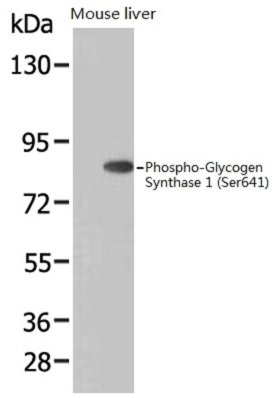 Western blot analysis of extracts on Mouse liver cells treated with AP, using Phospho-Glycogen synthase 1 (Ser641) Rabbit Monoclonal Antibody (EAB21337) at 1:1000 dilution. The lane on the left is blocked with the phospho peptide.
 Immunohistochemical analysis of paraffin-embedded Mouse liver tissue, using Phospho-Glycogen synthase 1 (Ser641) Rabbit Monoclonal Antibody (EAB21337) at 1:100 dilution.
|
