

| Host / Isotype | Clonality | Applications | MW (kDa) | Reactivity |
| Rabbit IgG | Polyclonal | WB, IHC-P, IF/ICC, ELISA | 65 | Human, Mouse, Rat |
| Application Key | WB-Western Blot IP-Immunoprecipitation IHC-Immunohistochemistry IF-Immunofluorescence ICC-Immunocytochemistry FC-Flow Cytometry |
| Reactivity Key | H-Human M-Mouse R-Rat Mk-Monkey B-Bovine Pg-Pig Hm-Hamster Dg-Dog C-Chicken X-Xenopus Z-Zebrafish Hr-Horse All-All Species Expected |
| Applications Dilutions | |
| The application notes include recommended starting dilutions;optimal dilutions/concentrations should be detemined by the end user. | |
| WB(Westem Blotting) IHC-P(Immunohistochemistry-Paraffin) IF/ICC(Immunofluorescence/Immunocytochemistry) ELISA(Enzyme-linked Immunosorbent Assay) |
WB=1:500-2000 IHC-P=1:50-300 IF/ICC=1:50-300 |
| Product Information | |
| Conjugate | Unconjugate |
| Specificity | TGF-β Receptor II Rabbit Polyclonal Antibody detects endogenous levels of TGF-β Receptor II protein. |
| Purification | Affinity purification |
| Concentration | 1mg/ml |
| Format | Liquid |
| Formulation | In PBS, pH 7.4, containing 0.02% sodium azide,0.5% BSA and 50% glycerol. |
| Shipping | Gel Pack |
| Storage | Store at -20°C least 1 year from the date of shipment. avoid repeated freeze/thaw cycles. Aliquots may be stored at +4°C for 1-2 weeks. |
| UniProt ID | |
| Entrez Gene ID | |
| Product Description | |
TGF-β Receptor II also known as TGFβ RII, TGFBR2 is a single-pass type I transmembrane protein that plays a crucial role in the TGF-beta signaling pathway, which is essential for regulating cellular processes such as growth, differentiation, and apoptosis. The structural integrity of TGFβ RII, characterized by its extracellular ligand-binding domain and intracellular serine-threonine kinase domain, is vital for its function in signal transduction. Upon binding to TGF-beta ligands, TGFβ RII undergoes dimerization and phosphorylation, facilitating the recruitment and activation of type I receptors, which then propagate the signal through downstream Smad proteins to modulate gene expression. This structural mechanism is fundamental for maintaining cellular homeostasis and has significant implications in various physiological and pathological contexts, including cancer, fibrosis, and immune regulation. |
| Product Image Gallery | |
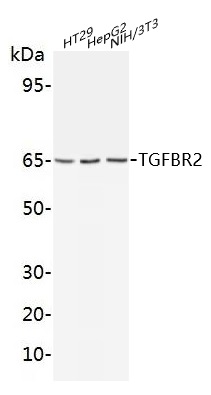 Western blot analysis of extracts on HT29, HepG2, NIH/3T3 cells, using TGF-β Receptor II Rabbit Polyclonal Antibody (EAB10550) at 1:1000 dilution. Secondary antibody Goat Anti-Rabbit IgG (H&L)-HRP (EAB21002) at 1:5000 dilution.
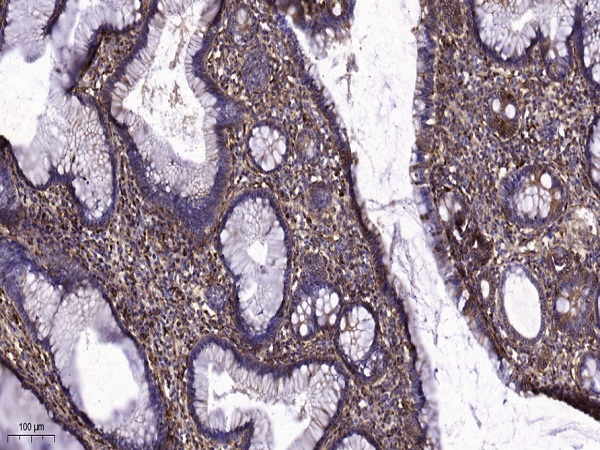 Immunohistochemical analysis of paraffin-embedded Human colon cancer tissue, using TGF-β Receptor II Rabbit Polyclonal Antibody (EAB10550) at 1:200 dilution.
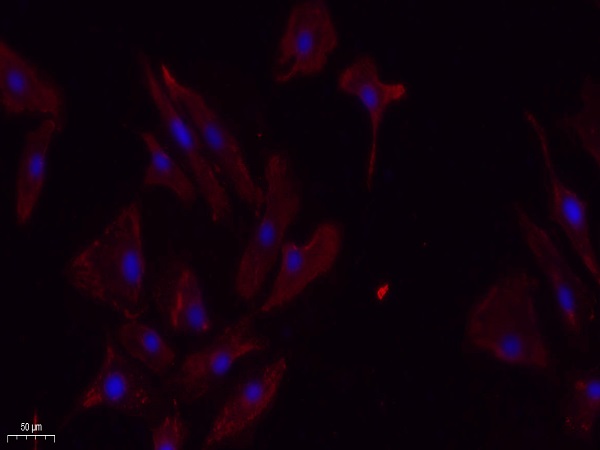 Immunofluorescence analysis of A549 cells, using TGF-β Receptor II Rabbit Polyclonal Antibody (EAB10550) at 1:200 dilution(4°C,overnight).
|
