

| Host / Isotype | Clonality | Applications | MW (kDa) | Reactivity |
| Rabbit IgG | Polyclonal | WB, IHC-P, IF/ICC, ELISA | 28 | Human, Mouse, Rat |
| Application Key | WB-Western Blot IP-Immunoprecipitation IHC-Immunohistochemistry IF-Immunofluorescence ICC-Immunocytochemistry FC-Flow Cytometry |
| Reactivity Key | H-Human M-Mouse R-Rat Mk-Monkey B-Bovine Pg-Pig Hm-Hamster Dg-Dog C-Chicken X-Xenopus Z-Zebrafish Hr-Horse All-All Species Expected |
| Applications Dilutions | |
| The application notes include recommended starting dilutions;optimal dilutions/concentrations should be detemined by the end user. | |
| WB(Westem Blotting) IHC-P(Immunohistochemistry-Paraffin) IF/ICC(Immunofluorescence/Immunocytochemistry) ELISA(Enzyme-linked Immunosorbent Assay) |
WB=1:500-2000 IHC-P=1:50-300 IF/ICC=1:50-300 |
| Product Information | |
| Conjugate | Unconjugate |
| Specificity | Phospho-14-3-3 zeta (Ser58) Rabbit Polyclonal Antibody detects endogenous levels of 14-3-3 zeta only when phosphorylated at Ser58. |
| Purification | Affinity purification |
| Concentration | 1mg/ml |
| Format | Liquid |
| Formulation | In PBS, pH 7.4, containing 0.02% sodium azide,0.5% BSA and 50% glycerol. |
| Shipping | Gel Pack |
| Storage | Store at -20°C least 1 year from the date of shipment. avoid repeated freeze/thaw cycles. Aliquots may be stored at +4°C for 1-2 weeks. |
| UniProt ID | |
| Entrez Gene ID | |
| Product Description | |
14-3-3 zeta is a member of the 14-3-3 protein family, which plays a crucial role in cellular signaling and regulation, particularly in cancer biology, where 14-3-3 zeta protein is involved in processes such as apoptosis, mitogenic signaling, and cell-cycle checkpoints. 14-3-3 zeta protein is primarily located in the cytoplasm, where 14-3-3 zeta protein interacts with various target proteins to modulate their activity and stability. This cytoplasmic localization allows 14-3-3 zeta protein to act as a regulatory hub, coordinating multiple signaling pathways essential for maintaining cellular homeostasis and responding to stress signals. Through binding to phosphorylated serine and threonine residues on ligands, 14-3-3 zeta protein can influence protein interactions and functions, impacting critical cellular processes. |
| Product Image Gallery | |
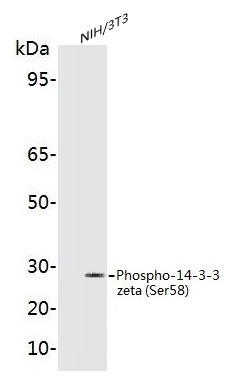 Western blot analysis of extracts on NIH/3T3 cells treated with UV, using Phospho-14-3-3 zeta (Ser58) Rabbit Polyclonal Antibody (EAB10506) at 1:1000 dilution. The lane on the left is blocked with the phospho peptide.
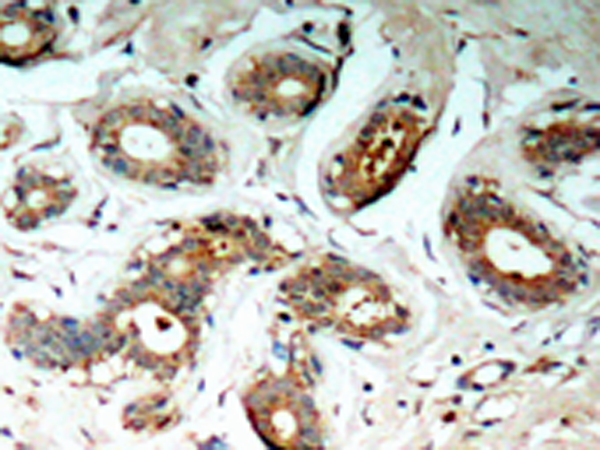 Immunohistochemistry analysis of paraffin-embedded Human breast carcinoma tissue, using Phospho-14-3-3 zeta (Ser58) Rabbit Polyclonal Antibody (EAB10506) at 1:100 dilution.
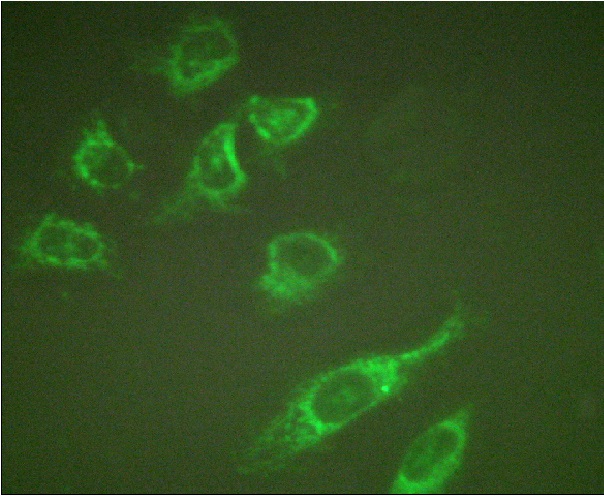 Immunofluorescence analysis of Hela cell, using Phospho-14-3-3 zeta (Ser58) Rabbit Polyclonal Antibody (EAB10506) at 1:100 dilution.
|
