

| Host / Isotype | Clonality | Applications | MW (kDa) | Reactivity |
| Mouse IgG1 | Monoclonal | WB, IP, IHC-P, IF/ICC | 134 | Human |
| Application Key | WB-Western Blot IP-Immunoprecipitation IHC-Immunohistochemistry IF-Immunofluorescence ICC-Immunocytochemistry FC-Flow Cytometry |
| Reactivity Key | H-Human M-Mouse R-Rat Mk-Monkey B-Bovine Pg-Pig Hm-Hamster Dg-Dog C-Chicken X-Xenopus Z-Zebrafish Hr-Horse All-All Species Expected |
| Applications Dilutions | |
| The application notes include recommended starting dilutions;optimal dilutions/concentrations should be detemined by the end user. | |
| WB(Westem Blotting) IHC-P(Immunohistochemistry-Paraffin) IF/ICC(Immunofluorescence/Immunocytochemistry) ELISA(Enzyme-linked Immunosorbent Assay) |
WB=1:500-2000 IP=1:20-200 IHC-P=1:50-300 IF/ICC=1:50-300 |
| Product Information | |
| Conjugate | Unconjugate |
| Specificity | EGFR Mouse Monoclonal Antibody detects endogenous levels of EGFR protein. |
| Purification | Affinity purification |
| Concentration | 1mg/ml |
| Format | Liquid |
| Formulation | In PBS, pH 7.4, containing 0.02% sodium azide,0.5% BSA and 50% glycerol. |
| Shipping | Gel Pack |
| Storage | Store at -20°C least 1 year from the date of shipment. avoid repeated freeze/thaw cycles. Aliquots may be stored at +4°C for 1-2 weeks. |
| UniProt ID | |
| Entrez Gene ID | |
| Product Description | |
EGFR plays a crucial role in cell signaling pathways that regulate cell proliferation, survival, and differentiation. Located primarily on the cell membrane, EGFR is activated upon binding to ligands, such as epidermal growth factor (EGF) and transforming growth factor alpha (TGFα), leading to receptor dimerization and subsequent activation of intrinsic tyrosine kinase activity. This activation triggers a cascade of downstream signaling pathways, including the RAS-RAF-MAPK and PI3K-AKT pathways, which are essential for normal cellular functions and tissue homeostasis. However, aberrant activation of EGFR is frequently associated with various cancers, as EGFR can lead to uncontrolled cell division and tumor progression. EGFR′s ability to undergo post-translational modifications, such as phosphorylation, further enhances signaling capabilities and contributes to oncogenic potential. |
| Product Image Gallery | |
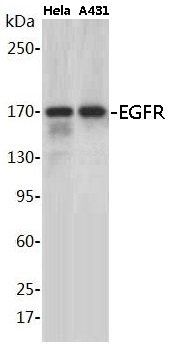 Western blot analysis of extracts on Hela, A431 cells, using EGFR Mouse Monoclonal Antibody (EAB10313) at 1:2000 dilution. Secondary antibody Goat Anti-Mouse IgG (H&L)-HRP (EAB21001) at 1:5000 dilution.
Predicted band size: 134 kDa; Observed band size: 170 kDa 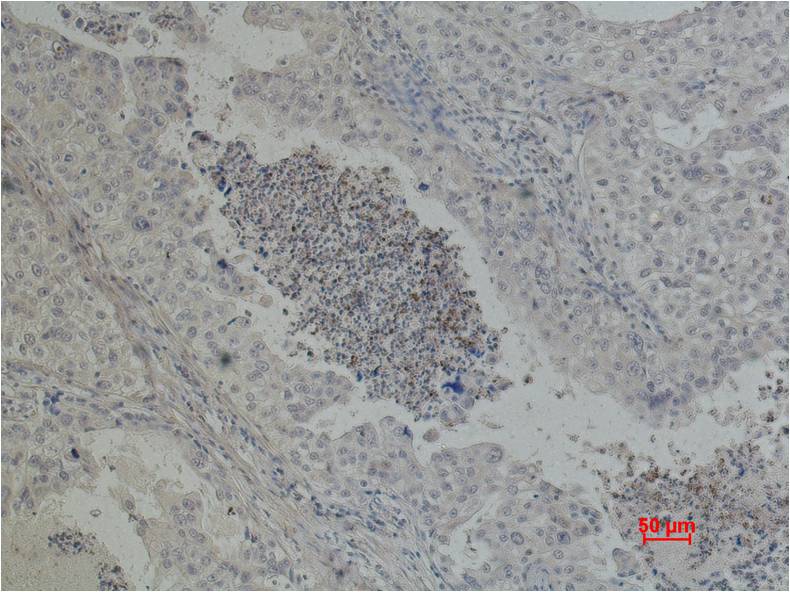 Immunohistochemical analysis of paraffin-embedded Human lung caricnoma tissue, using EGFR Mouse Monoclonal Antibody (EAB10313) at 1:200 dilution.
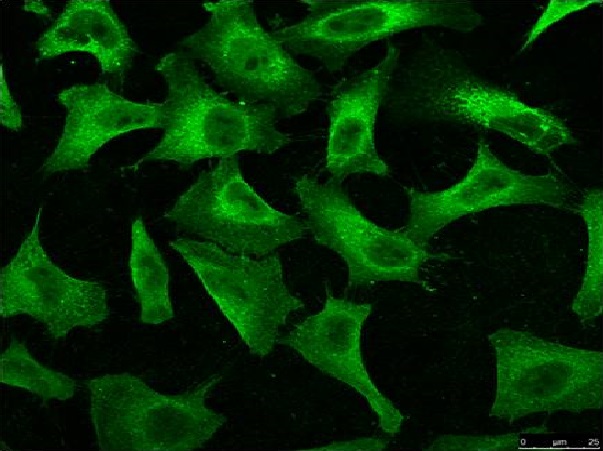 Immunofluorescence analysis of Hela cells, using EGFR Mouse Monoclonal Antibody (EAB10313) at 1:100 dilution.
|
