

| Host / Isotype | Clonality | Applications | MW (kDa) | Reactivity |
| Rabbit IgG | Polyclonal | WB, IP, IHC-P, IF/ICC, ELISA | 47 | Human, Mouse, Rat |
| Application Key | WB-Western Blot IP-Immunoprecipitation IHC-Immunohistochemistry IF-Immunofluorescence ICC-Immunocytochemistry FC-Flow Cytometry |
| Reactivity Key | H-Human M-Mouse R-Rat Mk-Monkey B-Bovine Pg-Pig Hm-Hamster Dg-Dog C-Chicken X-Xenopus Z-Zebrafish Hr-Horse All-All Species Expected |
| Applications Dilutions | |
| The application notes include recommended starting dilutions;optimal dilutions/concentrations should be detemined by the end user. | |
| WB(Westem Blotting) IHC-P(Immunohistochemistry-Paraffin) IF/ICC(Immunofluorescence/Immunocytochemistry) ELISA(Enzyme-linked Immunosorbent Assay) |
WB=1:500-2000 IP=1:20-200 IHC-P=1:50-300 IF/ICC=1:50-300 |
| Product Information | |
| Conjugate | Unconjugate |
| Specificity | Phospho-GSK-3β (Ser9) Rabbit Polyclonal Antibody detects endogenous levels of GSK-3β only when phosphorylated at Ser9. |
| Purification | Affinity purification |
| Concentration | 1mg/ml |
| Format | Liquid |
| Formulation | In PBS, pH 7.4, containing 0.02% sodium azide,0.5% BSA and 50% glycerol. |
| Shipping | Gel Pack |
| Storage | Store at -20°C least 1 year from the date of shipment. avoid repeated freeze/thaw cycles. Aliquots may be stored at +4°C for 1-2 weeks. |
| UniProt ID | |
| Entrez Gene ID | |
| Product Description | |
GSK-3β also known as GSK3beta, GSK3B is a serine/threonine kinase with a highly conserved structure, featuring a kinase domain essential for phosphorylating various substrates. GSK-3β′s structure includes an ATP-binding pocket and a catalytic core that enables interaction with other proteins, allowing regulation of multiple signaling pathways, including those involved in glycogen synthesis and cell cycle control. The structural integrity of GSK-3β is crucial for activity, as alterations in conformation can disrupt the ability to phosphorylate key substrates, leading to impaired cellular functions. GSK-3β′s kinase domain also contains regions responsible for recognizing specific phosphorylation sites on substrates, further influencing regulatory role in cellular processes. This structural precision is particularly important in maintaining normal cell functions and has been implicated in various diseases, including neurodegenerative disorders. |
| Product Image Gallery | |
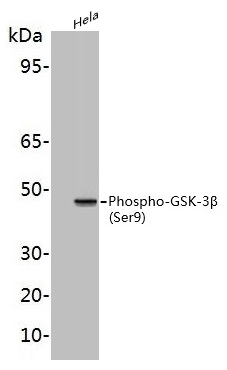 Western blot analysis of extracts on Hela cells treated with EGF, using Phospho-GSK-3β (Ser9) Rabbit Polyclonal Antibody (EAB10229) at 1:1000 dilution. The lane on the left is blocked with the phospho peptide.
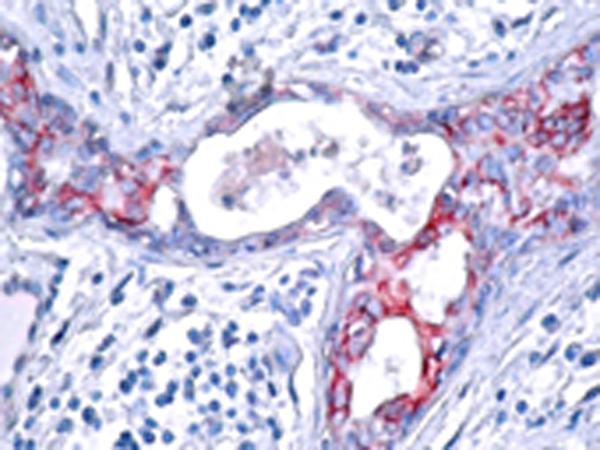 Immunohistochemistry analysis of paraffin-embedded Human breast carcinoma tissue, using Phospho-GSK-3β (Ser9) Rabbit Polyclonal Antibody (EAB10229) at 1:100 dilution.
|
