Photo:010-62890160
| Biological Activity | |||||||||||||||||||||||||
| Synonyms | PF-06840003, EOS200271 | ||||||||||||||||||||||||
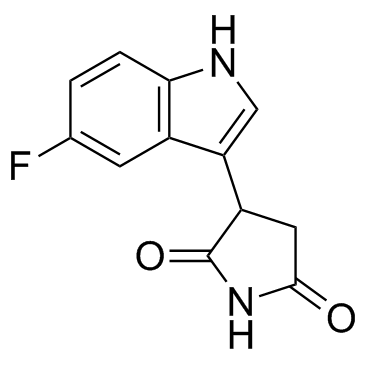
| Chemical Name | 3‑(5-Fluoro‑1H‑indol-3-yl)pyrrolidine-2,5-dione | ||||||||||||||||||||||||
| Application | PF06840003 is a specific and oral active IDO-1 inhibitor | ||||||||||||||||||||||||
| CAS Number | 198474-05-4 | ||||||||||||||||||||||||
| Purity | ≥99.0% | ||||||||||||||||||||||||
| Molecular Weight | 232.21 | ||||||||||||||||||||||||
| Molecular Formula | C₁₂H₉FN₂O₂ | ||||||||||||||||||||||||
| SMILES | O=C(C(C1=CNC2=C1C=C(F)C=C2)C3)NC3=O | ||||||||||||||||||||||||
| Target & IC50 | hIDO-1: IC50 = 0.41 μM dIDO-1: IC50 = 0.59 μM mIDO-1: IC50 = 1.5 μM |
||||||||||||||||||||||||
| Shipping | Gel Pack | ||||||||||||||||||||||||
| Storage | Store at -20°C | ||||||||||||||||||||||||
|
|||||||||||||||||||||||||
| Solubility | |
| DMSO: 46 mg/mL (198.10 mM) Ethanol: 6 mg/mL (25.84 mM) |
| Product Description | |
PF-06840003 is an orally available hydroxyamidine and inhibitor of indoleamine 2,3-dioxygenase 1 (IDO1),with potential immunomodulating and antineoplastic activities. Upon administration, IDO1 inhibitor PF-06840003 targets and binds to IDO1, an enzyme responsible for the oxidation of tryptophan into kynurenine. By inhibiting IDO1 and decreasing kynurenine in tumor cells, PF-06840003 increases and restores the proliferation and activation of various immune cells, including dendritic cells (DCs), natural killer (NK) cells, and T lymphocytes; PF-06840003 also induces increased interferon (IFN) production, and causes a reduction in tumor-associated regulatory T cells (Tregs). Activation of the immune system, which is suppressed in many cancers, may inhibit the growth of IDO1-expressing tumor cells. IDO1, a cytosolic enzyme responsible for tryptophan catabolism and the conversion of tryptophan into kynurenine, is overexpressed by a variety of tumor cell types and antigen presenting cells (APCs); it plays an important role in immunosuppression. Tryptophan depletion inhibits T-lymphocyte proliferation and activation, and subsequently suppresses the immune system. |